
How do I know if my stores are cannibalising each other?
Grow without cannibalising your network. Here is how to see where your stores overlap, and how much that overlap matters.
Store cannibalisation happens when two outlets of the same network compete for the same customers, so a new opening mostly moves existing customers around. Measure it by drawing the same drive-time catchment around every store, counting the residents who fall in more than one and checking loyalty data to see where shoppers actually come from.
Why is cannibalisation hard to see in your sales reports?
Each store reports its own sales. When a new opening draws customers from an older store nearby, the network total can look healthy while one of the two quietly weakens.
Overlap is a matter of travel time, not of boundaries. Networks that assign whole postcodes to the nearest store draw clean lines on a map, but households near the line often sit within an easy drive of both.
Catchments are also uneven. A store beside a motorway exit reaches much further than one on a congested strip, so two stores the same distance apart can overlap heavily or hardly at all.
residents in an average Australian postcode. Moving one postcode from a store to another moves thousands of people, and still hides the households that can reach both.
Average computed from the ABS Estimated Resident Population 2024 (27.2 million) over 2,644 postcodes (ASGS 2021), K-Stra territory v5, 30 September 2026.
How do you measure cannibalisation between stores, step by step?
List every store
Your own stores, open and planned, with coordinates or a full address that can be geocoded.
Draw the catchment of each
The same drive or walk time around every store, built on the road network rather than as circles.
Measure the overlap
Count the residents who fall in two or more catchments, store by store and as a share of each catchment.
Add the competitors
Residents that a competitor can also reach are contested too. See how much of each catchment others share.
Check against real customers
With customer or loyalty-card data, see where each store’s shoppers actually live and which of them also use your other stores.
Test a change before making it
Add a planned point and compare coverage and overlap with and without it.
Decide on measured overlap
Keep, move, close or open: base the call on overlap you have measured, not on overlap you suspect.
What data do you need for a cannibalisation analysis?
A list of your stores is enough to start. Customer or loyalty data turns an estimate of overlap into a measure of it.
Your store list
A CSV or Excel file with name and address, or coordinates, for every store, open or planned.
How My Data worksResidents on the road network
ABS population estimates spread onto address points, so a shared household is counted once.
See the dataCompetitors by brand
The stores of other brands in your sector, with address and status, to see which residents are contested.
See the dataCustomer or loyalty records
Cards or customers with an address or postcode and their spending by store and month.
How My Data works
K-Stra runs on a dedicated server in Sydney: your datasets, your analyses and your results stay in Australia. Map tiles, payments and sign-in never see your files. Three steps can: geocoding sends only the address text, and only after you confirm; the AI assistant reads column names and values when you ask it about a dataset; email notifications carry figures from your analysis.Where your data lives. Mark a dataset “session only” and it is deleted 24 hours after upload.
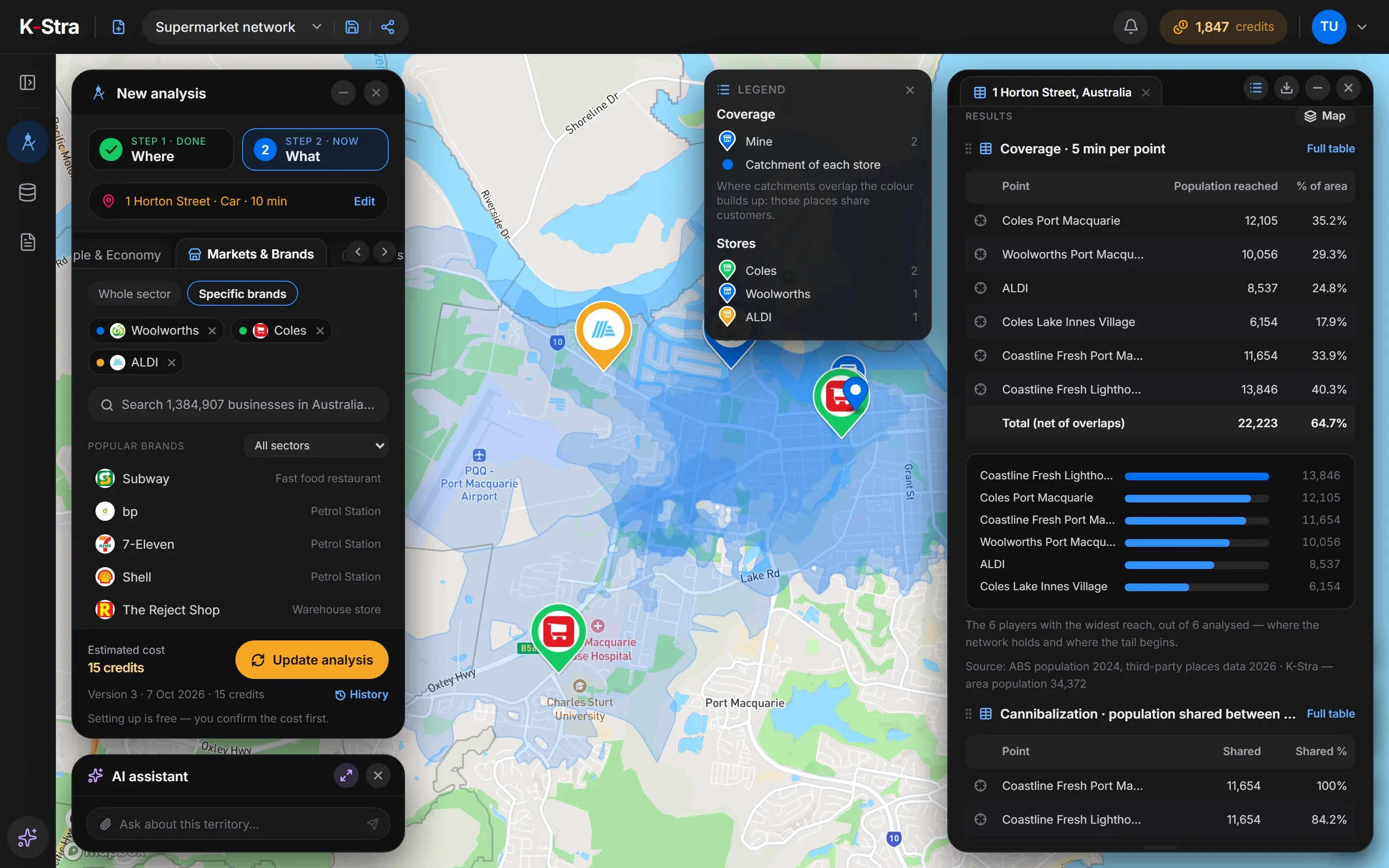
How do you measure cannibalisation in K-Stra?
Two modules answer two different questions. Coverage measures how your catchments overlap on the resident population; Customer Loyalty shows how your real customers behave.
- UploadLoad your stores into My Data from a CSV or Excel file. Rows without coordinates are geocoded only after you confirm the cost.
- CoverageFrom a Markets & Brands analysis, open Coverage, add your stores and mark each point as yours or a competitor’s. Choose the minutes of each catchment, up to 30.
- ReadSee the population each store reaches, the residents your own stores share, and how much of each catchment a competitor reaches too.
- CustomersWith loyalty-card data, Customer Loyalty shows where each store’s cardholders live, how spending fades with distance and where else in your network they shop.
A planned point on the map is calculated with and without it, so you see what an opening would change before you sign anything. Market share is measured only for your own stores, on your own loyalty data, within the perimeter you analyse.
What does store overlap look like in numbers?
Two stores of the same network in Port Macquarie NSW, each with a 5-minute catchment by car, against 4 supermarkets of the competition. Every resident the CBD store reaches is also reached by the Lighthouse Beach store: closing it would leave nobody without a store of the network.
| Store | Residents reached | Shared with the other store | Shared (%) | Also reached by a competitor |
|---|---|---|---|---|
| Coastline Fresh Port Macquarie CBD | 11,654 | 11,654 | 100% | 11,654 (100%) |
| Coastline Fresh Lighthouse Beach | 13,846 | 11,654 | 84.2% | 13,495 (97.5%) |
Sources: ABS population 2024. Store locations: a fictional two-store network in the K-Stra test account. Competitors: Coles, Woolworths and ALDI stores from the K-Stra places catalogue 2026. K-Stra analysis of 7 October 2026, 5 minutes by car from each store.
How much does a cannibalisation analysis cost?
Coverage is priced per point: 5 credits for every store or candidate you analyse, yours or a competitor’s. Customer Loyalty costs20 credits for every store analysed, including each store you add to a network analysis.
Addresses without coordinates are geocoded at 1.5 credits per 1,000 addresses, and only the rows actually geocoded are charged. The size of the area never changes the price.
- Markets & Brands, one brand5 credits per brand · the analysis Coverage opens from5 credits
- Coverage, 8 stores5 credits per store or candidate40 credits
- Customer Loyalty, 2 stores20 credits per store analysed40 credits
- Store file import1 credit per 10,000 rows1 credits
- Map, catchments, overlap tables and exportsFree
- This network check= 86 credits
The app quotes each step first, with the points it will charge, and runs nothing until you confirm.
What else do people ask about store cannibalisation?
What is sales cannibalisation?
It is the part of a store’s business that comes at the expense of another store in the same network rather than from new customers. Some is unavoidable in a dense network; the real question is whether an opening adds customers or only moves them.
How much overlap between two stores is too much?
There is no universal threshold: it depends on the sector and on how often people buy. Compare the shared residents with those each store reaches on its own; when most of a new store’s catchment is already shared, the opening mainly redistributes customers.
Do I need loyalty-card data to measure cannibalisation?
No. Coverage measures overlap on the resident population with nothing more than a list of store addresses. Customer or loyalty data adds what the population cannot tell you: where your actual shoppers live and which of your stores they use.
Can I include a store that is not open yet?
Yes. A point placed on the map can be marked as planned, and the analysis is calculated with and without it, so you see how coverage and overlap would change before you commit.
Can competitors’ stores be part of the analysis?
Yes. Each point is marked as yours or a competitor’s. For each of your stores, Coverage then shows how many of its residents a competitor can also reach, and how many competitors do.
What happens to my store file after the analysis?
It stays in My Data, inside your organisation, until you delete it. Mark it “session only” at upload and it is deleted 24 hours later. The first 50 MB are free. Beyond that, storage costs 2 credits per 100 MB a month.
Grow without
cannibalising your network.
Load your stores, draw their catchments and see where they overlap before the next opening.
Open the app — free to exploreCoverage is charged per store, after you confirm the estimate