
Isochrone, isodistance or radius: which should I use?
Three ways to draw the area around an address, three different counts of the people in it. On a coast or a river, the difference is not a detail.
Use an isochrone — the area reachable within a travel time — for customers who drive or walk to you. Use an isodistance, the same distance measured along the roads, when the cost of travel matters more than the time. Keep a radius for quick screening and for rules written in straight-line distance.
What is the difference between an isochrone and an isodistance?
| Area | What it covers | Use it for | Its limit |
|---|---|---|---|
| Radius | Every point within a straight-line distance of the site | Quick screening, and rules set “in a straight line” | Crosses water, rail lines and private land as if they were roads |
| Isodistance | Every point within a distance measured along the road network | Deliveries, service calls and anything paid by the kilometre | Treats a kilometre on a motorway like a kilometre in a shopping street |
| Isochrone | Every point within a travel time, by car, on foot or avoiding motorways | Customers who come to you: shops, clinics, gyms, childcare | Depends on the mode and the traffic you choose |
The names come from cartography: iso means equal, so an isochrone joins points at an equal time and an isodistance points at an equal distance along the roads. A radius is the special case where the road network is ignored.
How different are the counts on the same address?
Four analyses from 8 South Terrace, Fremantle WA, at the mouth of the Swan River, with the same map view. Residents are counted address by address inside each shape.
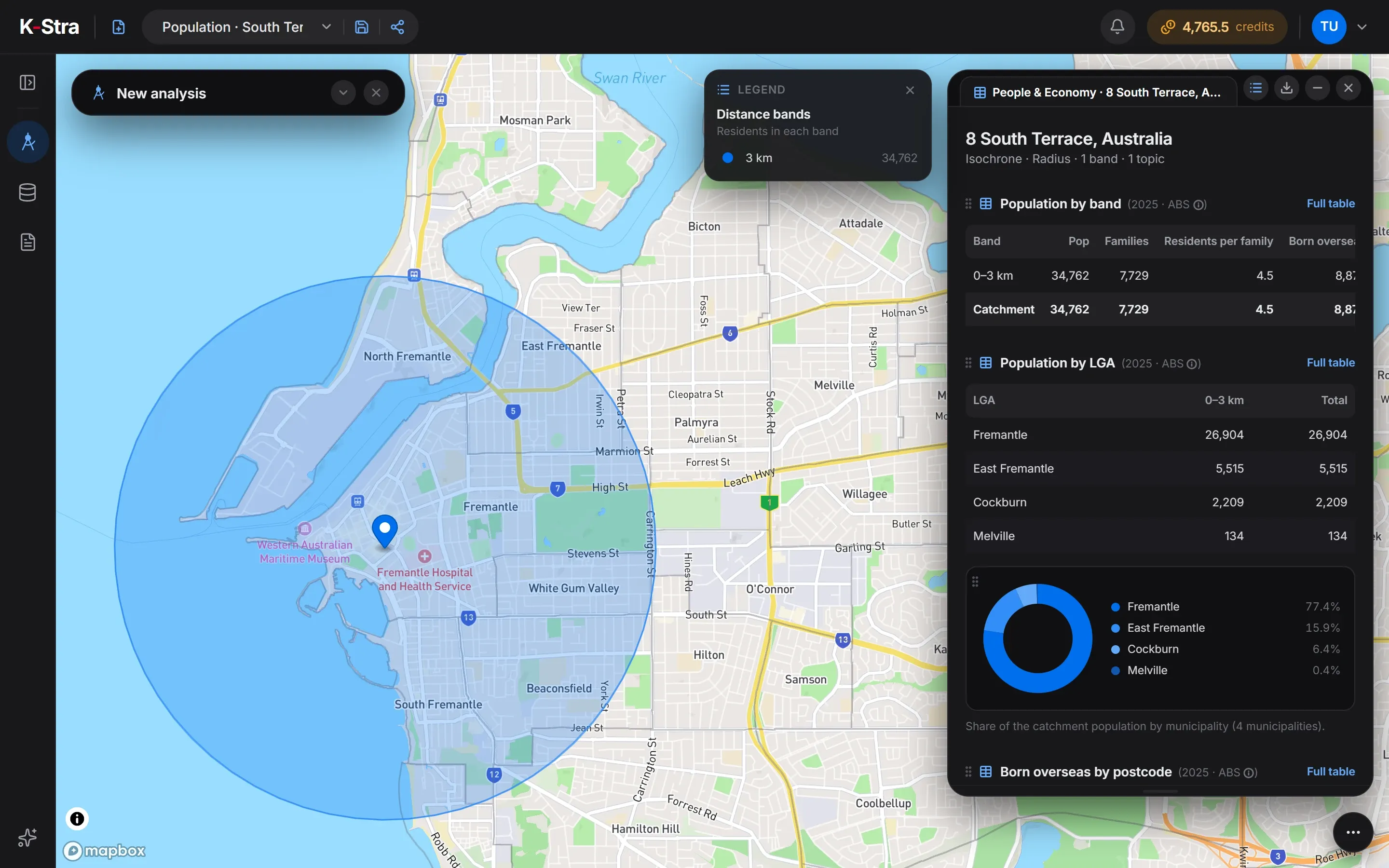 3 km radius
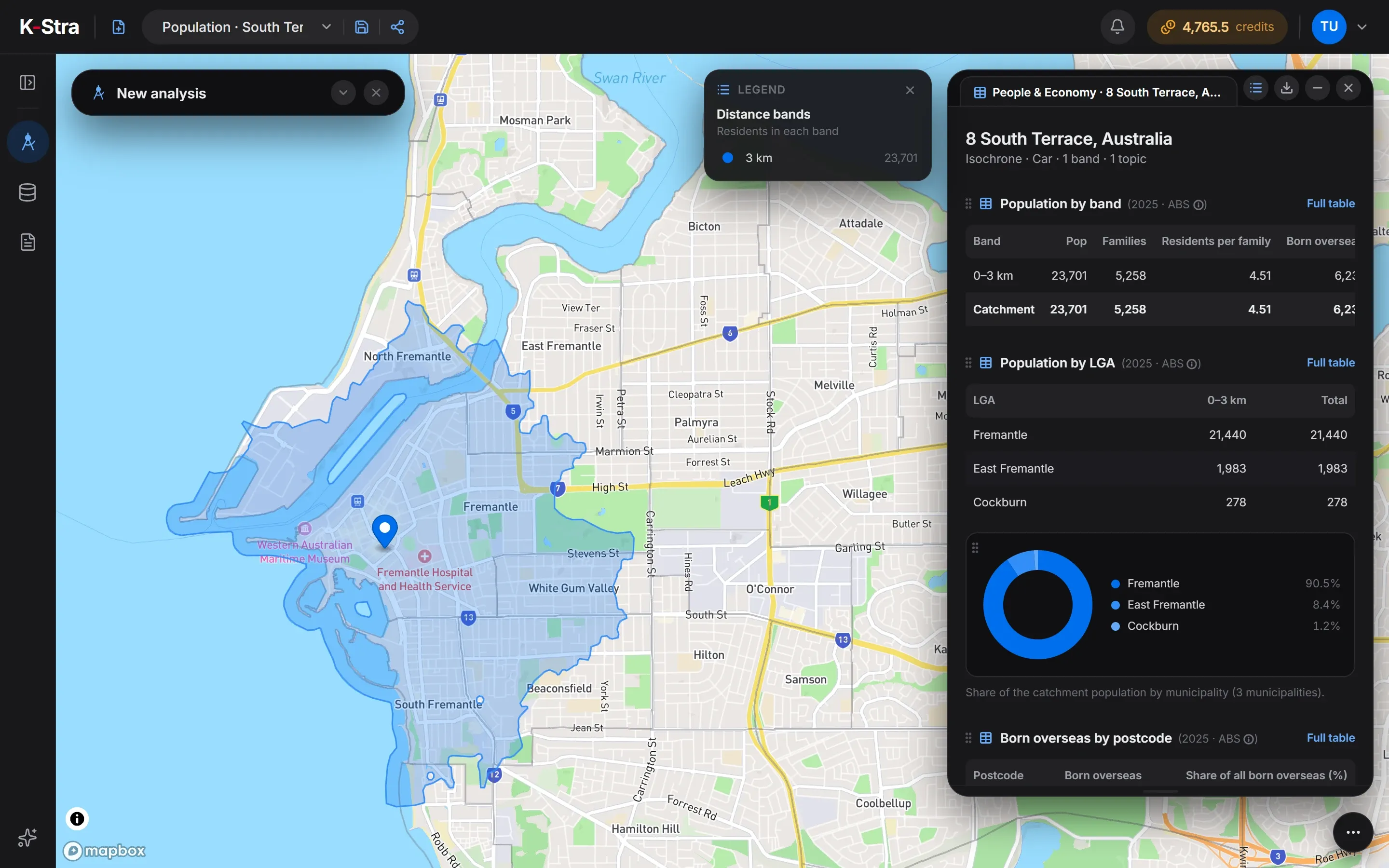 3 km by road
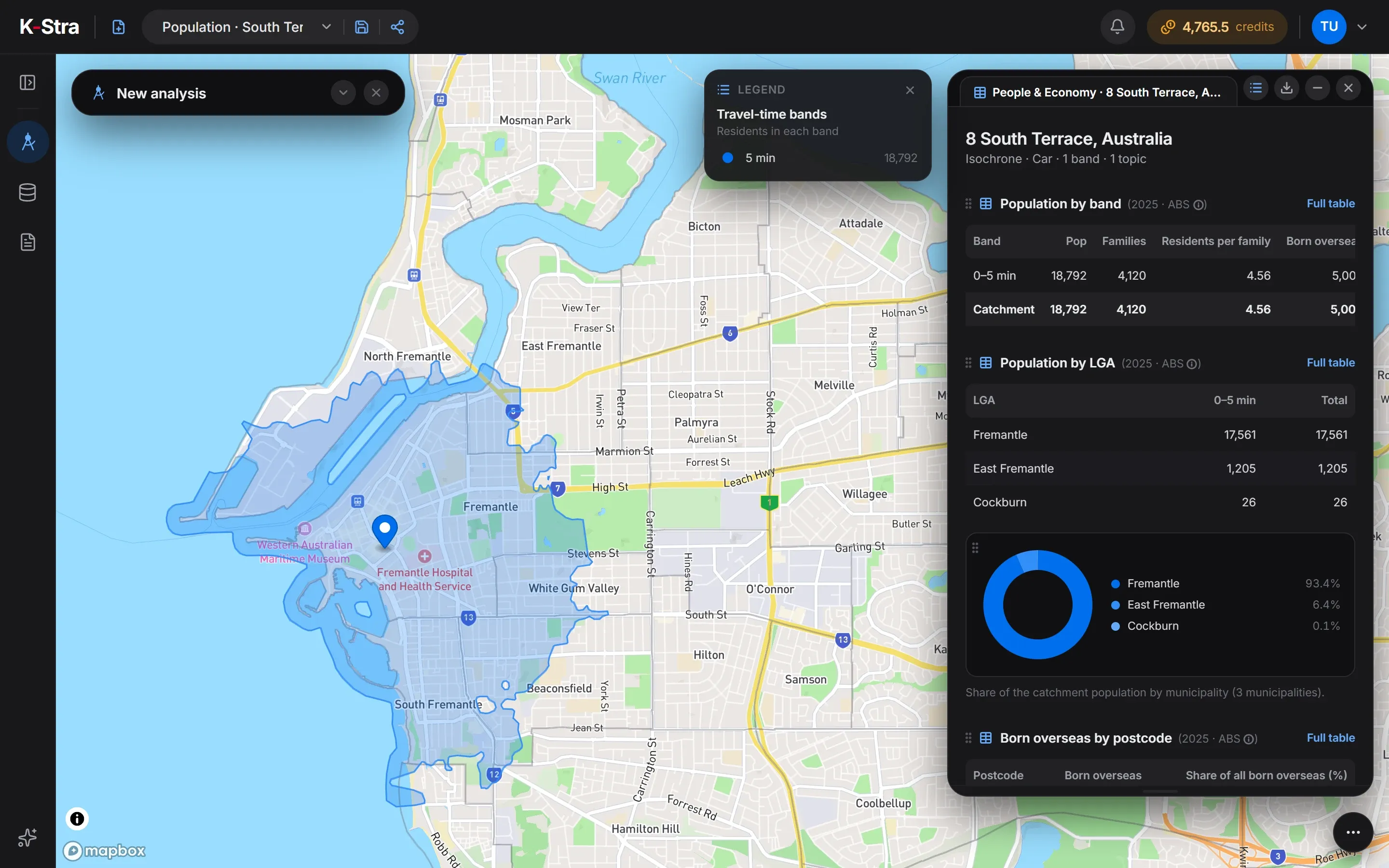 5 minutes by car
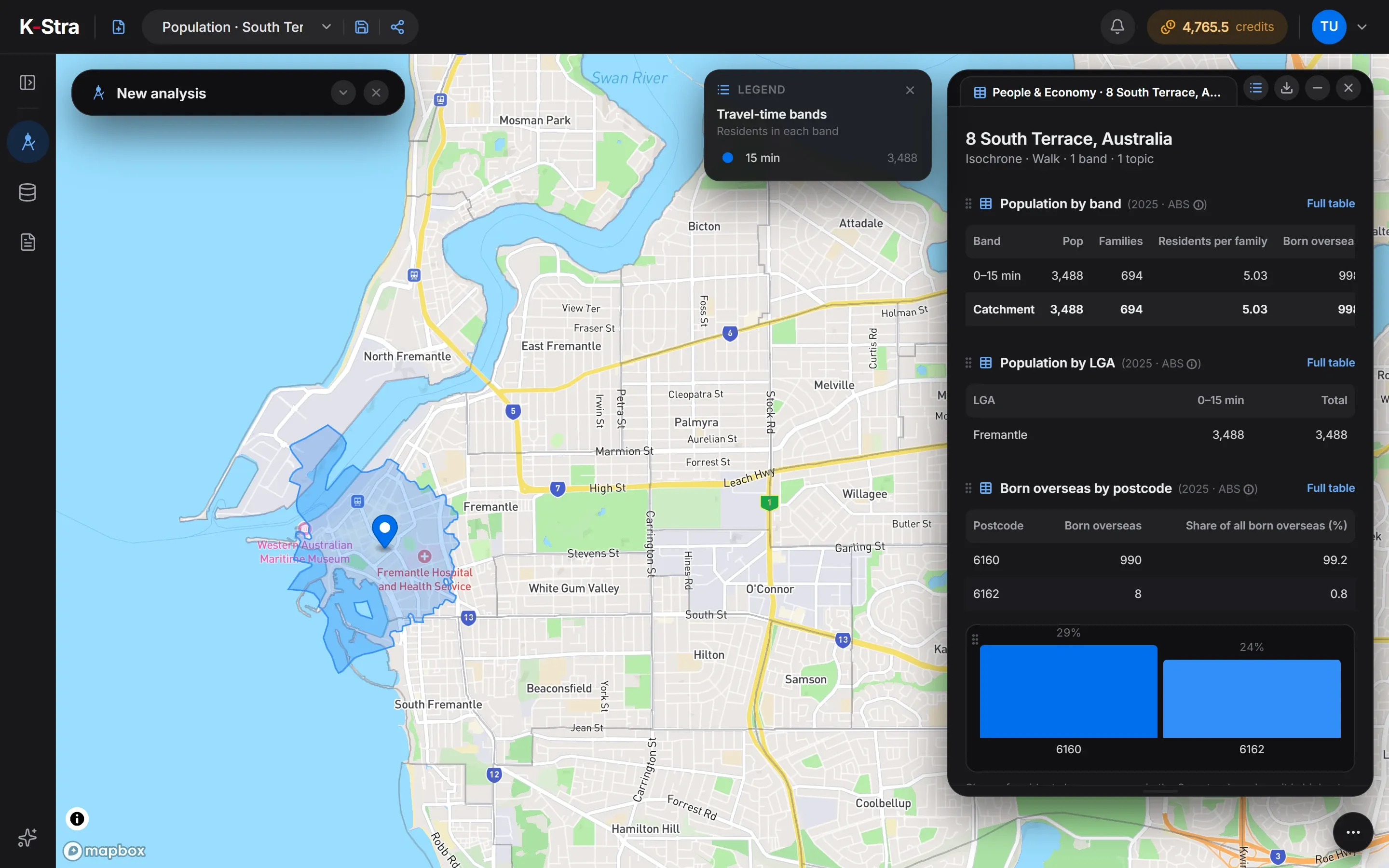 15 minutes on foot
| Area | Residents | Councils | In East Fremantle |
|---|---|---|---|
| 3 km radius | 34,762 | 4 | 5,515 |
| 3 km along the roads | 23,701 | 3 | 1,983 |
| 5 minutes by car | 18,792 | 3 | 1,205 |
| 15 minutes on foot | 3,488 | 1 | 0 |
The circle counts 47% more people than the same 3 km measured along the roads. Every council loses residents: East Fremantle falls from 5,515 to 1,983 and Cockburn from 2,209 to 278, because the river and the port lie between them and the address, and the bridges are few.
The road distance and the 5-minute drive give similar shapes and counts here, because the streets near the port are slow. On a motorway they part ways: five minutes cover more kilometres, and the isochrone stretches along the fast road while the isodistance does not.
Source: Four K-Stra analyses of 31 October 2026 from 8 South Terrace, Fremantle: a 3 km radius, 3 km along the roads, 5 minutes by car in average traffic and 15 minutes on foot. Residents: ABS Estimated Resident Population at 30 June 2025, spread onto addresses by K-Stra.
On-screen text
Where · Isochrone vs isodistance. One point, five different areas. 2 Market Street, Fremantle: by time, by distance, and a plain radius. 10 minutes by car. 10 minutes by car, no motorways. 20 minutes on foot. 5 km by car, along the roads. 5 km as the crow flies. Same 5 km: the radius counts sea and river. Measure reach the way people travel. Travel times and distances along the road network, average traffic.
When does a radius give the wrong answer?
On average, straight-line and road distances agree closely. A study in Montréal found correlations above 0.95 between the two, and a study of more than 66,000 points across the United States found an r² above 0.9.
The averages hide the places that matter. In Montréal the agreement was weaker in the outer suburbs; across the United States the important exceptions were near coasts and physical barriers such as rivers — the setting of Fremantle, and of most Australian cities.
The shape of the area also changes what you find. Researchers in Vancouver who drew 1 km areas around 1,311 people found effects with areas drawn on the street network that simple circles did not show.
Sources: Apparicio et al. (2008), International Journal of Health Geographics 7: 7; Boscoe, Henry and Zdeb (2012), The Professional Geographer 64(2); Oliver, Schuurman and Hall (2007), International Journal of Health Geographics 6: 41.
What else do people ask about isochrones?
Is a radius ever the right choice?
Yes, in three cases: a first look at many sites at once, a dense and regular street grid with no barriers, and any rule written in straight-line distance. New pharmacies in Australia, for example, are assessed on a straight line of 1.5 km from the nearest one.
Which travel time should I pick?
The time your customers are willing to spend for what you sell. A few minutes on foot for a café or a convenience store, 10 to 15 minutes by car for a supermarket, more for a destination store. Splitting the area into two or three bands shows how the count builds up.
Why does the walking area look so small?
Fifteen minutes on foot reach only the streets around the centre. Around South Terrace that is 3,488 residents, all in Fremantle: the right area for a business that lives on passing trade, the wrong one for a store people drive to.
What does “avoid motorways” change?
It removes the fastest roads from the network. The catchment shrinks along the motorway corridors and stays similar elsewhere, which suits customers who do not take the motorway for a short trip, or delivery vehicles that cannot.
Switch between
time, distance and radius.
In the Where step, the same address takes a drive time, a walk time, a road distance or a circle in one click.
Open the app — free to exploreDrawing areas is free