
Where should a manufacturer open its own store without hurting its stockists?
Your products already sell through other people’s shops. Your own store should add customers, not compete with the retailers who built your brand.
A manufacturer should open its own store where residents within reach spend heavily on its category and its existing stockists are not the ones serving them. Map the stockists with their catchments, test each candidate site against them, and prefer the site whose captured spending comes from the rest of the market rather than from partners.
What does a manufacturer need to know before opening a store?
Where is my category strong?
What residents spend on your category within reach of each area, and how many stores already compete for it.
Market potential analysisWill my store hurt my stockists?
The residents a new store would share with each retailer, and the spending it would take from them.
Cannibalisation analysisWhich site should I choose?
Up to five candidate sites compared on the spending they would capture and where it would come from.
Retail site selection
Why is a manufacturer’s first store different?
A retailer opening a store worries about competitors. A manufacturer has a second worry: its own customers, the stockists. A flagship opened next to the best of them can win the sales the stockist was already making for you, and lose the stockist too.
The instinct is to open where the brand already sells well. That is often exactly where a partner has done the work. The better site is usually one where the category has demand and none of your stockists reaches.
Answering that needs two maps at once: the market of the category, and the catchments of your stockists. Then every candidate site can be tested for how much of its spending comes from partners and how much from everyone else.
How do you place your own store around your stockists?
Map your stockists
Put every retailer that sells your products on the map, from a file or by clicking, and mark them as your own points.
Read your category
Run the sector your products belong to around the region: demand, the stores already competing and where the market is underserved.
Shortlist sites
Take candidates from the best locations, from commercial listings near them, or from addresses you already have in mind.
Test each site against the stockists
Simulate every candidate opening together with your stockists and the competition, and see where its spending would come from.
Choose on net new spending
Rank the sites on what they would capture minus what they would take from your partners, and check the range of the estimate.
Which K-Stra tools does a manufacturer use?
Your stockists on the map
Upload the list with addresses or coordinates, or click each retailer on the map.
Your own dataYour category’s market
Demand, competition, opportunity and the best locations for the sector of your store, at 40 credits.
Business and competition dataSite comparison
New sites simulated with your stockists and competitors: what each captures and from whom, at 20 credits a site.
Retail site selectionShared residents
Coverage counts the residents each stockist shares with the new store, at 5 credits a point.
Cannibalisation analysis
K-Stra runs on a dedicated server in Sydney: your datasets, your analyses and your results stay in Australia. Map tiles, payments and sign-in never see your files. Three steps can: geocoding sends only the address text, and only after you confirm; the AI assistant reads column names and values when you ask it about a dataset; email notifications carry figures from your analysis.Where your data lives. Mark a dataset “session only” and it is deleted 24 hours after upload.
What would a showroom take from four stockists?
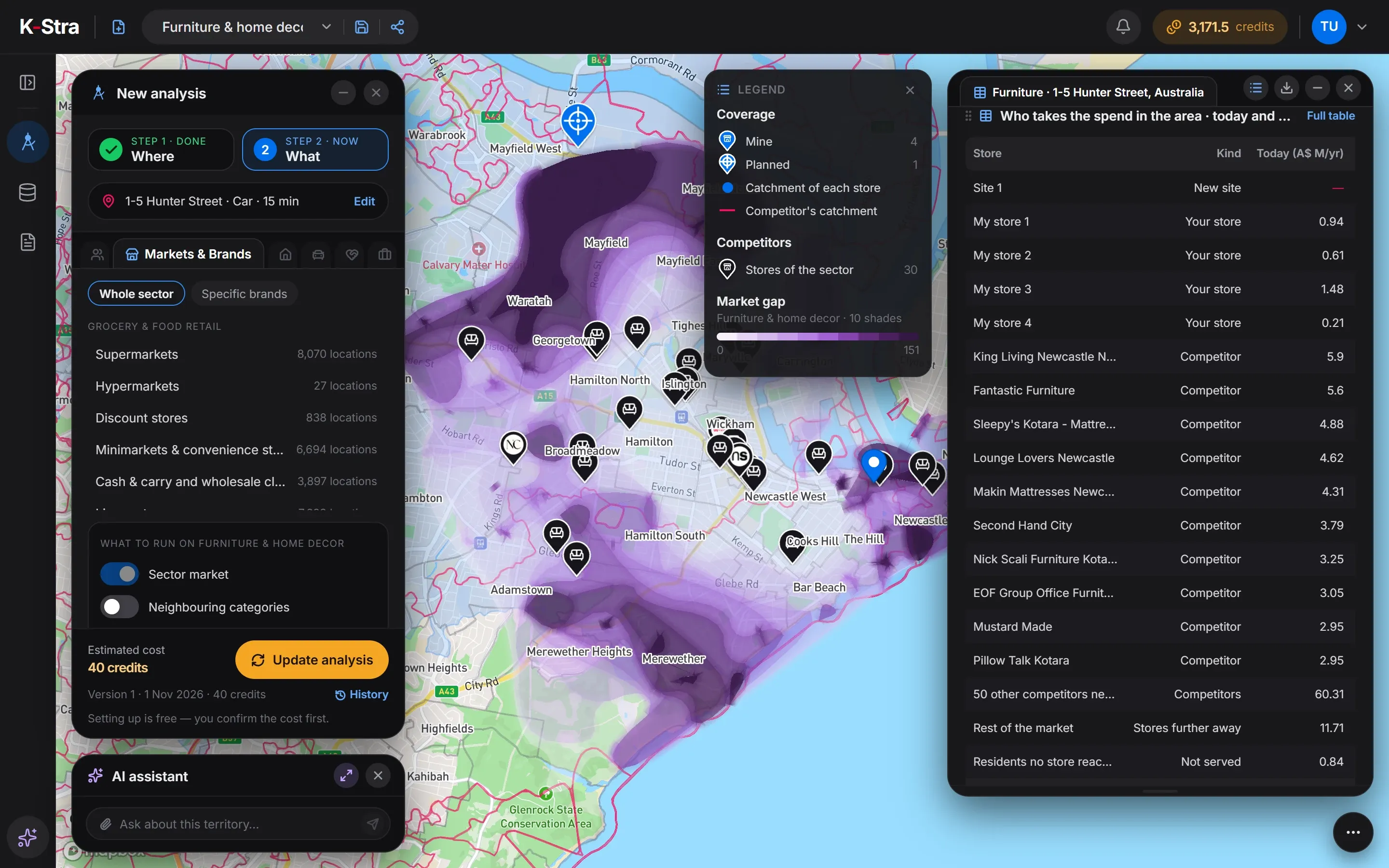
Take a furniture maker that sells through four stockists in Newcastle, at Kotara, Charlestown, Jesmond and Warners Bay, and is thinking of a showroom of its own in Mayfield West. Around the city centre there are 30 furniture and home decor stores, 3.65 per 10,000 residents against 2.47 in Australia.
The showroom’s 15-minute catchment holds 139,727 residents and 48 competing stores. K-Stra simulates it opening alongside the four stockists and the competition, and splits the residents’ spending on furniture among them all.
 Compare sites · Newcastle
How much would each stockist lose?
Modelled yearly spending of residents captured by each of the four fictional stockists, today and with the showroom open in Mayfield West, 15 minutes by car per store. These are modelled shares of the residents’ spending.
| Stockist | Today (A$ M a year) | With the showroom (A$ M a year) | Change |
|---|---|---|---|
| Kotara | 0.94 | 0.93 | −1.0% |
| Charlestown | 0.61 | 0.60 | −0.8% |
| Jesmond | 1.48 | 1.46 | −1.2% |
| Warners Bay | 0.21 | 0.20 | −0.7% |
Sources: K-Stra analysis of 1 November 2026: furniture and home decor stores within a 15-minute drive of 1-5 Hunter Street, Newcastle, and a site comparison with 15-minute catchments. The four stockists are fictional points placed on the map. Businesses: K-Stra places catalogue, October 2026. Residents: ABS population estimates at 30 June 2025. Spending: ABS national accounts, 2024–25, and the K-Stra sector model.
How much would a showroom in Mayfield West take from the stockists?
In this example the stockists lose little. The showroom would capture about A$2.12 million a year of residents’ spending on furniture, between A$1.61 and A$2.71 million depending on how strong it is. Only A$0.03 million, 1.4% of it, would come from the four stockists; the largest fall is Jesmond’s, 1.2%, and the other three lose less.
The largest single source, 39.3% of the capture, is Fern Bay, across the Hunter River, where no furniture store reaches within its catchment today. That is new ground. The four stockists are invented and placed on the map for this example, so read the result as an illustration of the method, not as a finding about Newcastle. Treat the figures as an order of magnitude for comparing sites: residents only, and the Newcastle centre also draws visitors and workers the model leaves out.
How much does this analysis cost?
The Newcastle example cost 60 credits. Testing three sites instead of one adds 40 credits; the stockists cost nothing in the comparison.
- Markets & Brands, your categoryper sector, any area40 credits
- Compare sites, one new siteper candidate site20 credits
- Your stockists in the comparisonFree
- The Newcastle example= 60 credits
- ≈ A$92 at the Single report pack rate of A$1.53 a credit; less with larger packs and monthly plans.
Optional, not in the total
- Coverage of stockists and the new store5 credits per store or candidate+ 5 credits
The estimate appears before the run starts, and a run that fails costs nothing.
What else do manufacturers ask?
Can K-Stra tell how much my own store would take from my stockists?
It estimates how much of the catchment residents’ yearly spending on your category the store could capture, and how much of that would come from each of your stockists, each competitor and the rest of the market. It is a model of resident spending for comparing sites of the same sector and area, and its absolute value is an order of magnitude.
Do I need to upload my stockist list?
Either upload it, with addresses or coordinates, or click the stockists onto the map. A list of businesses with their addresses is enough; no customer data is needed.
What if my products are sold in several categories of store?
Run the sector that matches the store you plan to open — furniture, sporting goods, clothing — because that is the spending your store will compete for. Your stockists are counted as your points whatever kind of shop they are.
Can I test more than one site?
Yes: one to five new sites in the same comparison, at 20 credits each, all simulated as opening together, with the residents they would share with each other.
Does K-Stra count online sales?
No. It models what residents spend in physical stores of the sector, from ABS household spending. Online orders and visitors from outside the catchment are outside the model.
Open where your
stockists don’t reach.
Put your stockists on the map, run your category and test your candidate sites against them.
Open the app — free to exploreExploring the map is free; you pay only for the analyses you run