
How do I choose a location for a gym?
Members join the gym that fits their week, not the one with the best equipment across town. Here is how to measure who is within reach and who already competes for them.
Choose a gym location by counting the residents within a ten-minute drive, especially those aged 20 to 44, then every fitness business that competes for them: gyms, studios, martial arts and boxing. Compare gyms per 10,000 residents with the council, the state and Australia, and look for growing areas where spending is high and competition thin.
Which fitness businesses does K-Stra map?
K-Stra sorts sport and fitness into four sectors. Gyms & fitness centres is the broad one: it holds clubs and 24-hour gyms, but also yoga and pilates studios, boxing gyms, martial arts schools and personal trainers, because they all compete for the same hours of the same people.
Swimming pools, padel and tennis, and sports centres are separate sectors. A gym analysis can add them as neighbouring categories, together with sporting goods, physiotherapy, wellness, cafés and supermarkets, counted per 10,000 residents in the same area.
| Sector in the app | Locations | What it counts |
|---|---|---|
| Gyms & fitness centers | 19,491 | Gyms, fitness centres, studios, boxing and martial arts, and outdoor gyms in parks. |
| Swimming pools | 2,099 | Public and private swimming pools and swim schools. |
| Padel & tennis | 3,471 | Tennis and padel courts and clubs. |
| Sports centers | 8,884 | Sports and recreation centres, indoor courts. |
Source: the Gyms & Sport group in the sector list of the K-Stra app on 1 November 2026, with the names the app uses; business catalogue of 23 October 2026, built from public online business listings. The counts here are the whole catalogue, as on the Australia pages; the national figure in the per 10,000 table of the example below counts only the locations K-Stra can place on an Australian address, so it can be a few places lower, which moves its rate by at most a hundredth.
Which numbers matter most for a gym?
Residents aged 20 to 44
Gyms sell mostly to adults of working age, so a suburb of young households and a retirement area are not the same market. Around Werribee 38% of residents are 20 to 44, and the average age is 36.
In the app: People & Economy, Age, in five-year groups with the average age and the old-age index.
Gyms per 10,000 residents
Australia has 7.06, Victoria 6.61. Below the state figure, an area may be under-served; far above it, every new club splits the same members.
In the app: the table of businesses per 10,000 residents for the catchment, the council, the state and Australia.
Who counts as a competitor
A pilates studio and a 24-hour gym chase different members, a free outdoor gym chases none. The category of each business decides how much of the count really matters to you.
In the app: the store table, with a category for every business and a filter.
Residents within a 10-minute drive
The K-Stra model measures gym demand on a 10-minute drive: members choose a club close to home or work. Walk-time bands are there for inner-city studios.
In the app: the Where step, by car, with or without motorways, or on foot.
Market gap in growing suburbs
New suburbs can fill with households before fitness clubs follow. Residents around Werribee spend about A$309 a head a year on what gyms sell; the market gap shows where it meets the least competition.
In the app: the Market gap map, then the five best locations, each at least 500 m from the others.
What data do you need to assess a gym site?
The age of residents, every fitness business around them and spending on recreation. Your own member counts can be added from a spreadsheet.
Residents by age
ABS population estimates at 30 June 2025 by age and sex, spread address by address, in five-year groups.
Population dataEvery fitness business
19,491 gym and studio locations and three more sport sectors, with category, address, rating and reviews, from public online business listings.
Business and competition dataSpending on fitness
Household spending from the ABS national accounts for 2024–25, assigned to gyms, which drives demand and opportunity.
Work, income and spendingYour members, if you have them
Member counts by postcode, without names, imported into My Data and shown on the same map as the catchment.
My Data
K-Stra runs on a dedicated server in Sydney: your datasets, your analyses and your results stay in Australia. Map tiles, payments and sign-in never see your files. Three steps can: geocoding sends only the address text, and only after you confirm; the AI assistant reads column names and values when you ask it about a dataset; email notifications carry figures from your analysis.Where your data lives. Mark a dataset “session only” and it is deleted 24 hours after upload.
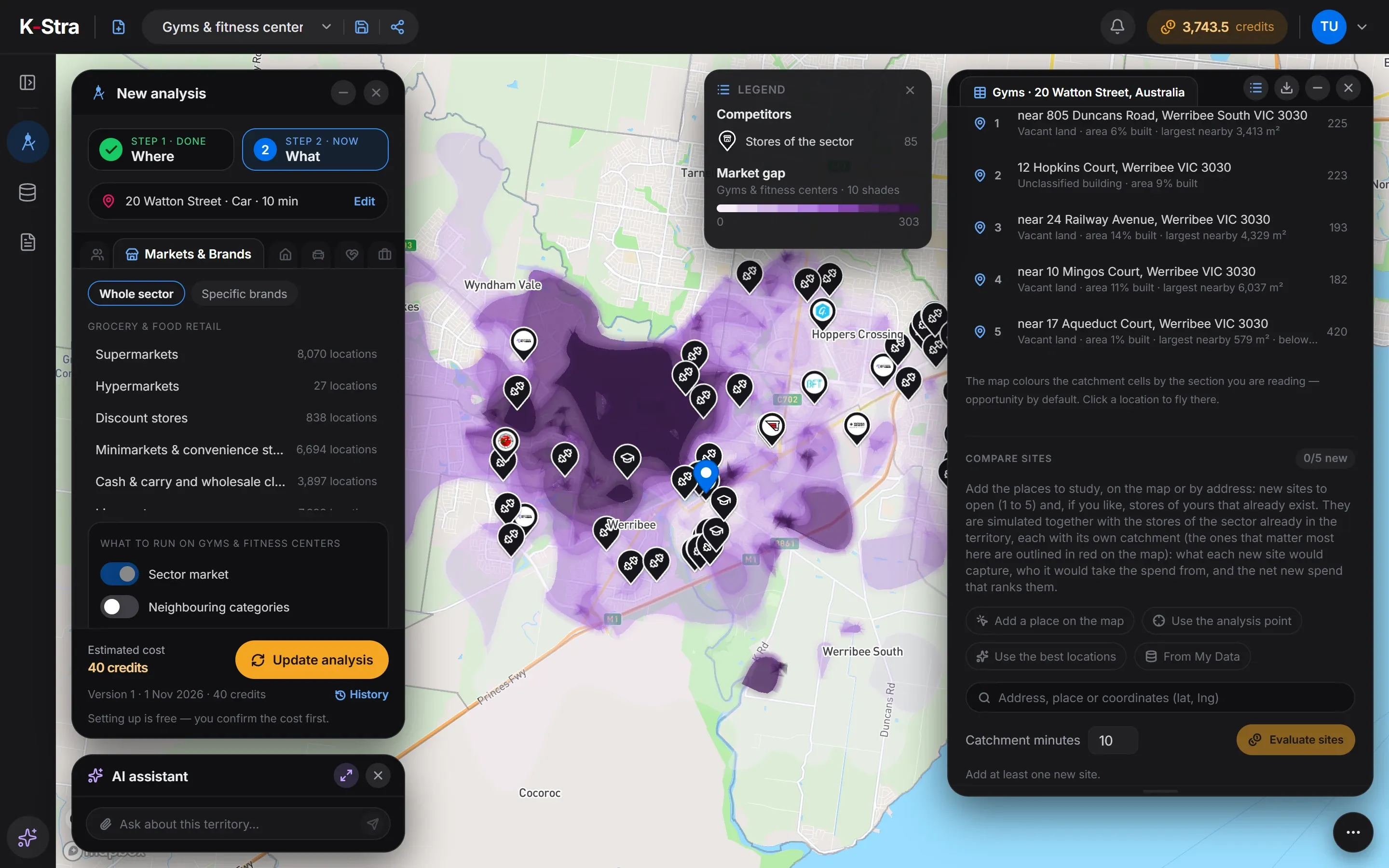
How do you analyse a gym site in K-Stra?
Markets & Brands with Gyms & fitness centers as a whole sector, and People & Economy with Age on the same area. Each shows its price before it runs.
- WhereThe address and a 10-minute drive, the reach the sector model uses for gyms. Walk-time bands suit a city-centre studio.
- WhatMarkets & Brands, whole sector, Gyms & fitness centers, for 40 credits; then People & Economy, Age, for 2.
- ReadDemand, competition and market gap on the map, every business with its category in a table, and the age of residents.
What does a gym analysis show?
Fitness businesses within 10 minutes by car of 20 Watton Street, Werribee VIC: 85 for 147,832 residents, 5.75 per 10,000 against 7.06 in Australia. Of the 85, 35 are listed as gyms — 11 of them free outdoor gyms in parks — and the rest are martial arts schools, fitness centres, yoga and pilates studios, boxing gyms and personal trainers. 22% of residents are children, against 17.4% in Australia, and 11.5% are 65 or over, against 17.5%.
| Area | Businesses | Residents | Per 10,000 residents |
|---|---|---|---|
| Catchment | 85 | 147,832 | 5.75 |
| Wyndham (council) | 182 | 347,830 | 5.23 |
| Victoria | 4,674 | 7,073,859 | 6.61 |
| Australia | 19,484 | 27,613,654 | 7.06 |
Sources: K-Stra analyses of 1 November 2026: gyms and fitness centres, and the age of residents, within a 10-minute drive in average traffic of 20 Watton Street, Werribee. Businesses: K-Stra places catalogue, October 2026. Residents by age: ABS Estimated Resident Population at 30 June 2025, spread onto addresses by K-Stra. Spending: ABS national accounts, 2024–25.
Is Werribee short of gyms?
Compared with the rest of the country, yes. The catchment has 5.75 fitness businesses per 10,000 residents and the Wyndham council area 5.23, both below Victoria’s 6.61 and Australia’s 7.06, in an area with more children and fewer older residents than average. Take away the 11 outdoor gyms and the gap widens.
The market gap shows where to look: the top locations are near 805 Duncans Road, Werribee South; 12 Hopkins Court, Werribee; and 24 Railway Avenue, Werribee, with indices of 225, 223 and 193 against 100 for the typical spot in the analysis.
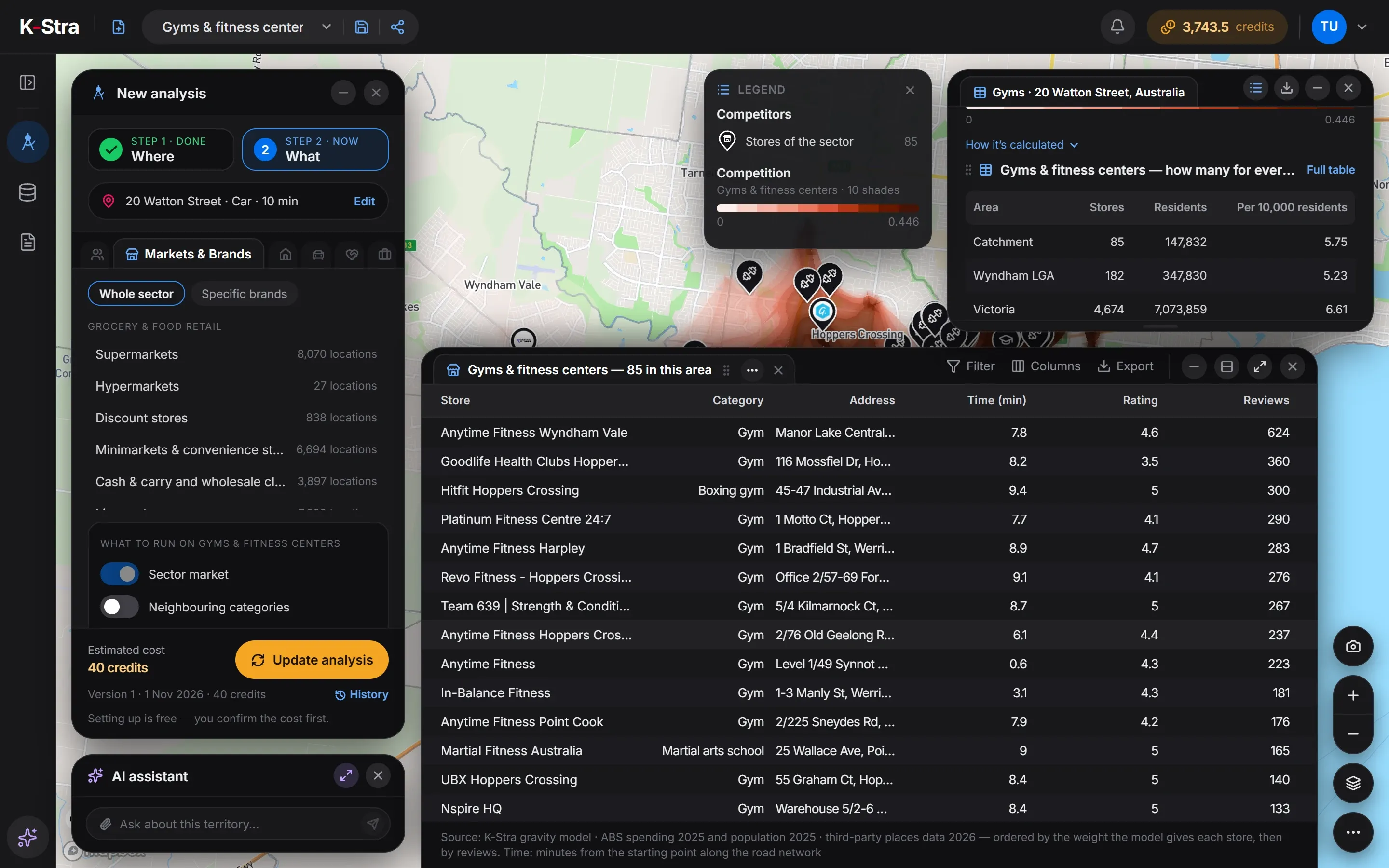 Businesses · Werribee
How much does a gym analysis cost?
The Werribee example cost 42 credits on 133 km². A whole metropolitan region would cost the same: you pay for the questions, not the size of the area.
Pools, padel and tennis, or sports centres are another 40 credits each, if you want them analysed as sectors of their own.
- Markets & Brands, Gyms & fitness centersper sector, any area40 credits
- People & Economy, Ageper topic2 credits
- Maps, tables and exports of the resultsFree
- Total= 42 credits
- ≈ A$64 at the Single report pack rate of A$1.53 a credit; less with larger packs and monthly plans.
Optional, not in the total
- Compare candidate sitesper candidate site+ 20 credits
The estimate appears before each run starts, and a run that fails costs nothing.
What do people opening a gym ask next?
How far will members travel?
Draw drive-time or walk-time bands on real roads and see who lives in each one, instead of guessing with a circle on a map.
Catchment area analysisWhich of my candidate sites is stronger?
Run the same model on one to five addresses and compare the residents’ spending each could capture, and from which clubs. It counts residents’ spending only, so use it to compare sites in the same sector and area: the absolute value is an order of magnitude, and workers, commuters, tourists and passing trade are not in it.
Retail site selectionHow do I split territories between franchisees?
Territories with a similar number of residents for every franchisee, within a reasonable drive of each club.
Franchise territory planning
What else do people ask about gym locations?
How many residents does a gym need in Australia?
On average there is one fitness business for every 1,417 Australians: 19,484 for 27,613,654 residents, or 7.06 per 10,000. The count includes studios, martial arts schools and outdoor gyms, so a full-size club needs a much larger catchment than that.
Are yoga, pilates and martial arts studios counted as gyms?
Yes. The Gyms & fitness centers sector holds every business listed as a gym, fitness centre, studio, boxing gym or martial arts school, and the table shows the category of each. In the Werribee example 50 of the 85 are not plain gyms.
Why are outdoor gyms in the list?
Because public listings classify them as gyms. They are free equipment in parks, not businesses, but they appear in the count and in the competition: 11 of the 85 in the Werribee example. The table shows them by name, so you can see how much they move the density.
Does K-Stra show the estimated annual sales of competing gyms?
No. Estimated annual sales exist only for existing retail stores, always as a band with its confidence and never as a figure; gyms, studios and other services never have one. K-Stra shows each competitor’s location, travel time, rating and number of reviews, which is often the better sign of a busy club.
Can I map where my members live?
Yes, as counts by postcode or by address without names: import a spreadsheet into My Data and colour the map with it. Datasets must not contain personal data, so remove names and contact details first. See customer mapping.
See who trains
around your site.
Type an address, pick Gyms and read the residents, the competition and the gaps on one map.
Open the app — free to exploreExploring the map is free; you pay only for the analyses you run