
Should I relocate my store, and where to?
A lease ending is a decision point. Before renewing or moving, compare the site you have with the sites you could have, on the same numbers.
To decide whether to relocate a store, measure the current site and each candidate the same way: the same drive-time catchment, the residents and spending within it, and the competitors that share it. Move only if a candidate would capture clearly more of the residents’ spending, after allowing for what the current site draws from workers and visitors.
Why is it hard to know whether a store should move?
The current site has history and the candidates have none. Its sales are real, theirs are guesses, so the comparison usually ends up between a known figure and an optimistic one.
The obvious candidate is the one with the most people around it. But a populous area often has the most competitors too, and the share a new store can win there is small.
And a move changes who you reach. A central store loses the people who work nearby; a suburban one gains residents who never came into town. Both effects need to be on the table.
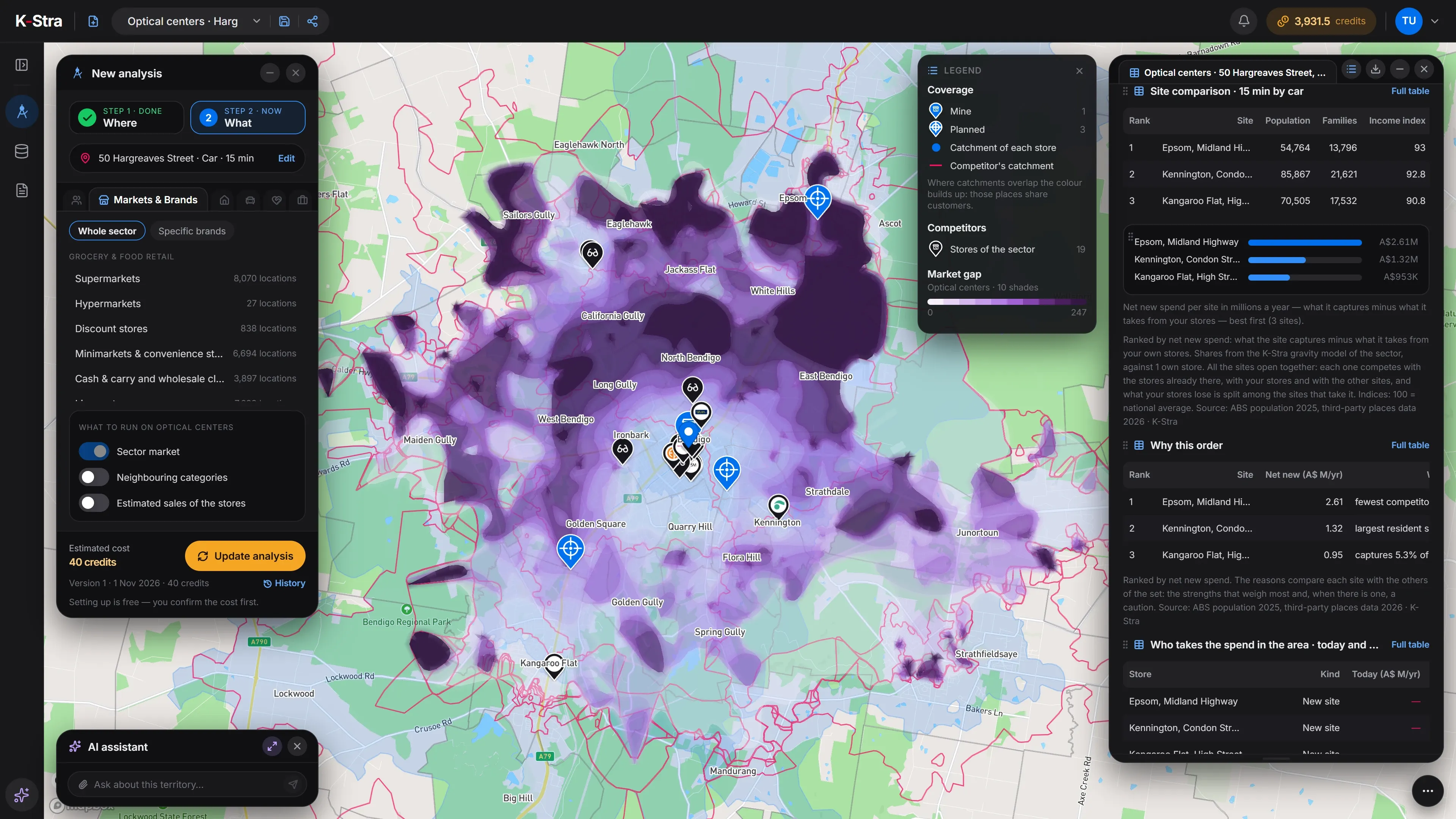
the share of residents’ spending that the best Bendigo candidate would capture, compared with the candidate that has the most spending within reach. The biggest market was not the best site.
K-Stra site comparison of 1 November 2026, optical centres, 15 minutes by car: 18.6% of A$14.82 million a year against 5.9% of A$23.2 million; ABS population and spending 2025.
 Optical centres · Bendigo
How do you decide whether to relocate a store, step by step?
Write down why you would move
Rent, space, parking, a lease ending or a shift in where customers live: the reason decides what the new site must do better.
Shortlist the candidates
Two to five real sites, with addresses, including at least one you would not have thought of first.
Measure them all the same way
The same drive time around the current store and every candidate, so the comparison is fair.
Count the competition
The stores of your sector within each catchment: a big market already crowded can be worth less than a smaller one.
Model the spending each would capture
How the residents’ spending in the sector would divide among your site, the candidates and every competitor.
Allow for what residents miss
A central store also serves workers and visitors. Weigh that before trading it for a suburban site.
Decide on a range
Compare low, central and high estimates, and move only when the candidate wins across the range.
What data do you need to compare a relocation?
The address of your store and of the candidates. Residents, spending and competitors come with the analysis.
Your store and the candidates
Addresses or points on the map: up to five new sites, plus the stores you already have.
Retail site selectionThe competition
Every store of your sector that can reach the area, with its own catchment.
Competitor analysisResidents within reach
ABS population estimates at 30 June 2025, with income and spending indices against the national average.
Population dataSpending in your sector
Household spending from ABS data, assigned to your sector by its spending model.
Income and spending data
K-Stra runs on a dedicated server in Sydney: your datasets, your analyses and your results stay in Australia. Map tiles, payments and sign-in never see your files. Three steps can: geocoding sends only the address text, and only after you confirm; the AI assistant reads column names and values when you ask it about a dataset; email notifications carry figures from your analysis.Where your data lives. Mark a dataset “session only” and it is deleted 24 hours after upload.
How do you compare a relocation in K-Stra?
Run your sector on the area around the store, then open the site comparison with the store you have and the sites you could move to.
- Your sectorIn Markets & Brands, run the whole sector on a drive time around the store. 40 credits per sector.
- Add the placesAdd the current store as a store of yours, then up to five new sites by address, on the map or from the best locations.
- CompareEach new site costs 20 credits; your existing stores are included at no extra cost.
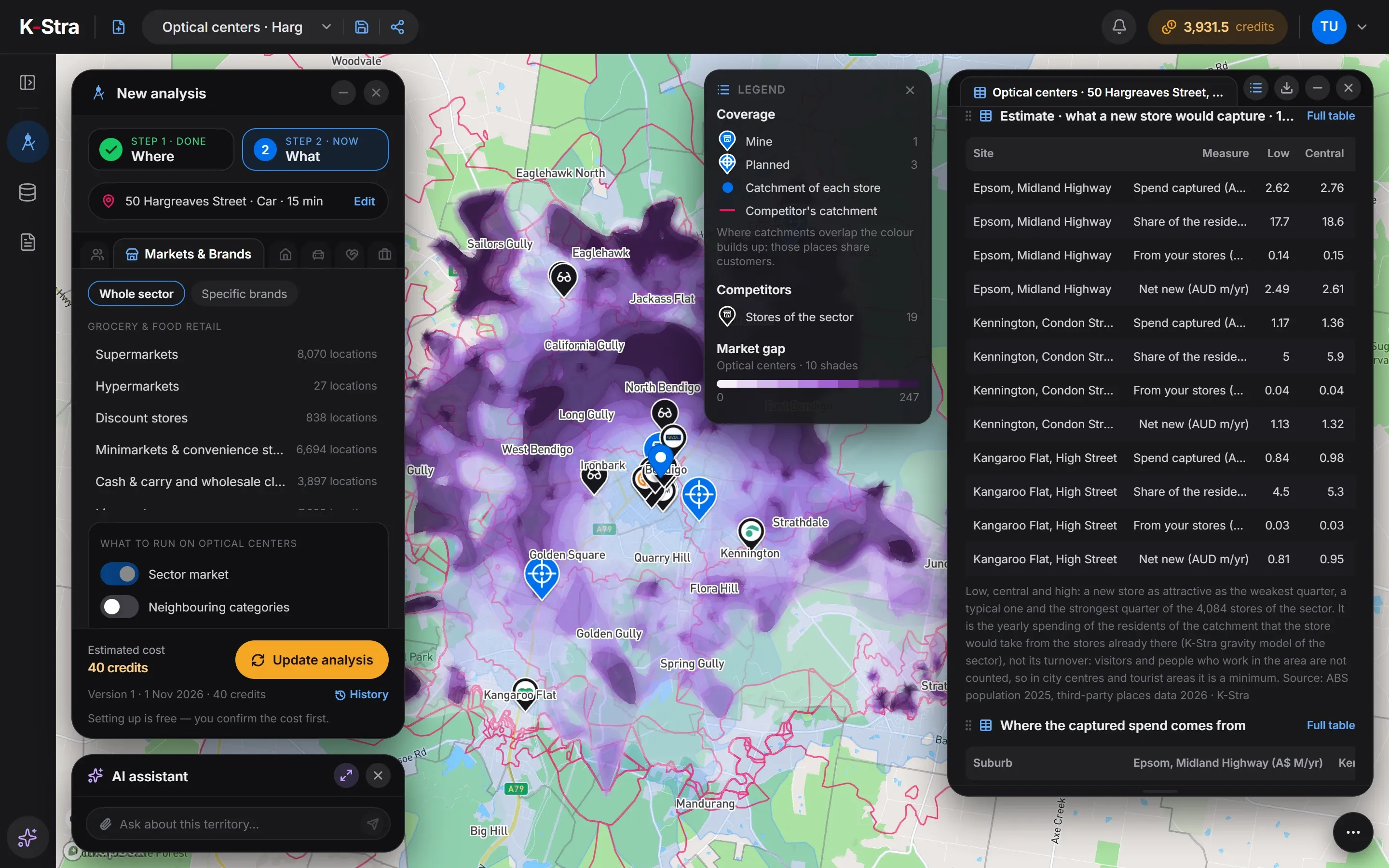
- ReadCaptured spending, share, what comes from your own stores, net new, why each site ranks where it does, and a low-to-high range.
The comparison also shows, for every store in the area, the residents’ spending it takes today and with the new sites. It is a model of the spending of residents only, built to compare sites of the same sector in the same area.
What does a relocation comparison look like in numbers?
A sample optical store at 50 Hargreaves Street, Bendigo VIC, against three candidate sites, each with a 15-minute catchment by car. Today the store captures about A$1.32 million a year of the residents’ spending in the sector. Epsom, the best candidate, would capture about A$2.76 million, 2.1 times as much, even with the other two open at the same time.
| Site | Residents within reach | Competitors | Residents’ spend within reach | Captured, central (low – high) | Share |
|---|---|---|---|---|---|
| Current store, central Bendigo | — | — | — | A$1.32M today | — |
| Epsom, Midland Highway | 54,764 | 16 | A$14.82M | A$2.76M (2.62 – 3.33) | 18.6% |
| Kennington, Condon Street | 85,867 | 18 | A$23.2M | A$1.36M (1.17 – 2.32) | 5.9% |
| Kangaroo Flat, High Street | 70,505 | 17 | A$18.61M | A$0.98M (0.84 – 1.7) | 5.3% |
Sources: K-Stra sector analysis and site comparison of 1 November 2026, optical centres, 15 minutes by car; ABS population and spending 2025; public online business listings, 2026. Spending of residents a year; workers and visitors are not counted.
Should the Bendigo store move?
On residents alone, Epsom wins clearly. It has the fewest competitors of the three, 16 within reach, and its low estimate, A$2.62 million, is above the high estimates of both other candidates.
Kennington is the trap: the most residents and the most spending within reach, A$23.2 million a year, but 18 competitors share it, and a new store would take only 5.9%.
The current store sits in the centre of Bendigo, among many of the competitors. Its figure counts residents only, and a town-centre store also serves people who work or shop there.
So the comparison does not say “move to Epsom”. It says Epsom is the site to beat, and that moving pays only if the centre’s workers and visitors are worth less than about A$1.44 million a year of residents’ spending. That is a question for the store’s own sales data.
The current store is hypothetical, placed at a central address for this example; the candidate addresses, the competitors, population and spending are real.
How much does a relocation comparison cost?
The sector analysis also gives the five best locations in the area, the stores of the sector and how many there are for every 10,000 residents.
Your existing stores are added to the comparison at no cost: only the new sites are charged.
- Markets & Brands, one sector40 credits per sector40 credits
- Site comparison, 3 new sites20 credits per candidate site60 credits
- Your current store in the comparisonFree
- This comparison= 100 credits
- ≈ A$153 at the Single report pack rate of A$1.53 a credit; less with larger packs and monthly plans.
The app quotes each step before it runs; a failed run costs nothing.
What else do people ask about relocating a store?
How do I compare my current store with a new site fairly?
Put both through the same model: the same drive time, the same population and spending data and the same competitors. In K-Stra the current store is added as a store of yours and the candidates as new sites, and they are simulated together.
Does the comparison include my customers who work in the centre?
No. It models the spending of the residents only. A store in a city centre, near a station or in a tourist area also serves people who work or stay there, so its figure is a minimum. That is the main reason not to read the comparison alone when the current store is central.
What does captured spending measure, and what does it leave out?
It is the potential spending of the catchment’s residents that a site would capture: a figure for comparing sites of the same sector and area, whose absolute value is an order of magnitude. Workers, commuters, tourists and passing trade are not in it, so CBD, tourist and station sites come out underestimated. Read the ranking as the result.
Can I compare more than one candidate at once?
Yes, up to five new sites, together with any number of your existing stores. They are simulated as opening together, so each one competes with the others as well as with the stores already there.
How do I choose the candidates?
Start from the sites you already know, then add some the analysis proposes: the best locations of the sector within the area, ranked by the spending a new opening could take.
Compare the site you have
with the sites you could have.
Run your sector around the store, add the candidates and see which would capture more, on the same numbers.
Open the app — free to exploreA sector 40 credits, each candidate 20