
How does a franchise network plan territories and new units?
A franchise grows on a promise: each franchisee gets a fair market and the next unit will not take it away. That promise is easier to keep when it is written in numbers.
A franchise network plans territories by building them from postcodes so that each holds a similar number of residents or households within a reasonable drive of its outlet, setting the smallest market a franchisee can live on, and checking every new unit for the residents it would share with neighbouring franchisees before granting it.
What does a franchisor need to settle before the next unit?
Are my territories fair?
Territories built from postcodes with the same residents or households each, and the drive each franchisee faces.
Franchise territory planningWill the new unit hurt its neighbours?
Residents a new outlet would share with existing ones, and the spending it would take from each.
Cannibalisation analysisWhere should the next units go?
Areas where the market for your sector is strong and no franchisee is present yet.
Store network planningIs this area big enough for a unit?
Residents within reach and what they spend each year on what your franchise sells.
Market potential analysis
Why do franchise territories cause disputes?
Territories are often drawn as circles or as a handful of postcodes picked on a map. Two franchisees who paid the same fee then find themselves with very different markets, and the one with less blames the network.
Growth makes it worse. Every new unit is a neighbour for someone, and without numbers the franchisor cannot show that the newcomer leaves the existing territory intact.
A territory written as a list of areas, with the residents in each and the drive from the outlet, is easier to defend. It can be checked by the franchisee, redrawn when the population changes, and compared fairly with every other territory in the network.
Which K-Stra tools does a franchise network use?
Balanced territories
Postcodes, suburbs or statistical areas shared out evenly on residents, households or customers, within a tolerance you choose.
Franchise territory planningCoverage and overlap
Every outlet with its catchment, the residents it shares with neighbours and those no outlet reaches.
Cannibalisation analysisYour sector’s market
Demand, competition and the best locations for the sector your franchisees work in, at 40 credits.
IndustriesLinks for franchisees
A saved analysis opens from a link, without an account and without spending your credits.
Sharing
K-Stra runs on a dedicated server in Sydney: your datasets, your analyses and your results stay in Australia. Map tiles, payments and sign-in never see your files. Three steps can: geocoding sends only the address text, and only after you confirm; the AI assistant reads column names and values when you ask it about a dataset; email notifications carry figures from your analysis.Where your data lives. Mark a dataset “session only” and it is deleted 24 hours after upload.
How different are four ways of drawing the same territories?
A sample franchise of 8 outlets in Perth WA shares out 59 postcodes with 1,329,353 residents. Handing each postcode to the nearest outlet gives one franchisee a territory 71.3% away from the average: the kind of gap that ends in a dispute.
Balanced on residents, every territory lands within ±10% of the average with the outlets where they are. The outlet-by-outlet result is on the franchise territory planning page; the table compares the four approaches.
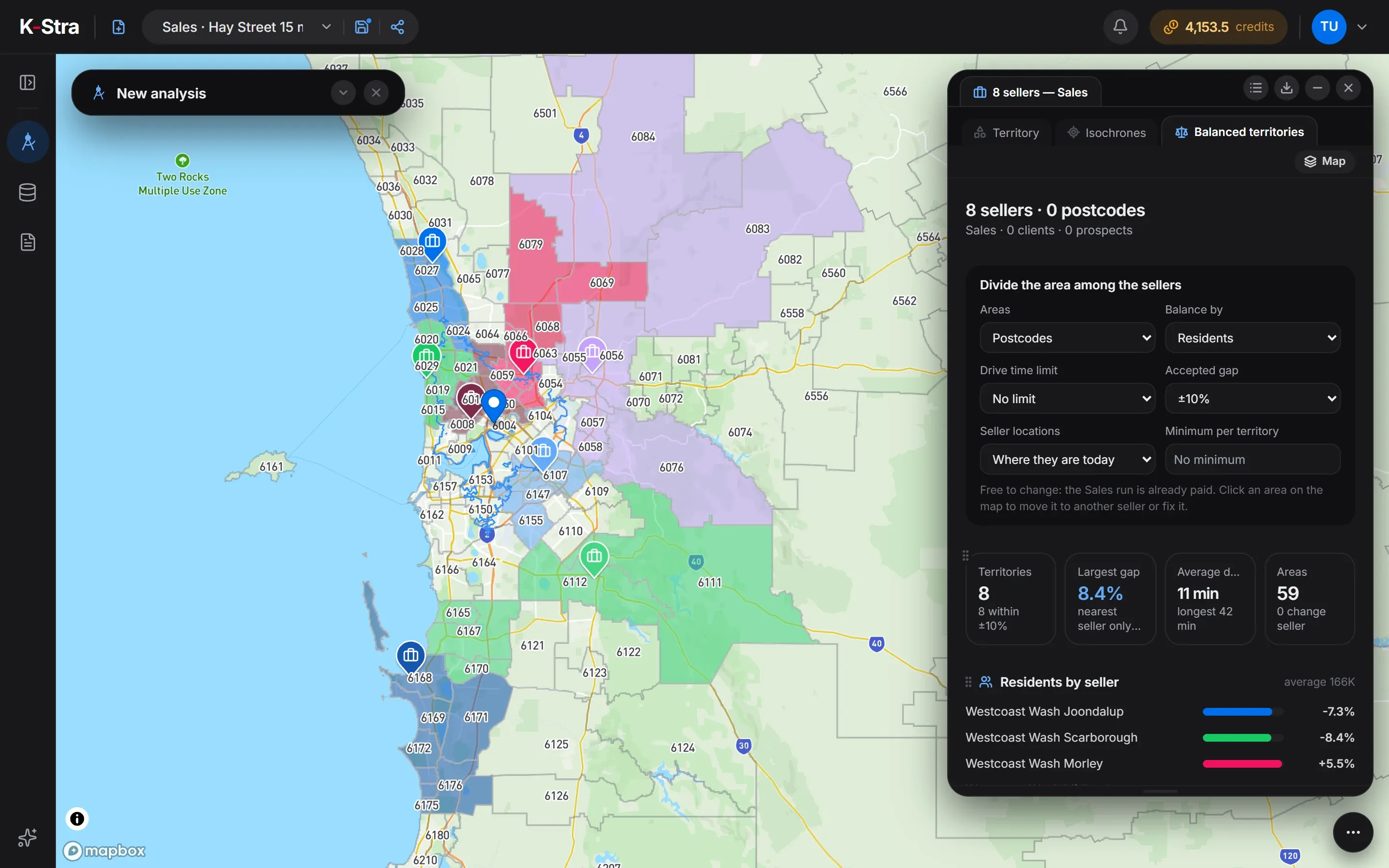 Territories · Perth
Which way of drawing territories is fairest?
The same 8 sample outlets and 59 postcodes, four ways. The largest gap is how far the biggest or smallest territory is from the average number of residents. For the nearest-outlet method only that gap was measured, so the other columns show a dash.
| Method | Within ±10% | Largest gap | Average drive |
|---|---|---|---|
| Each postcode to the nearest outlet | — | 71.3% | — |
| Balanced on residents, outlets where they are | 8 of 8 | 8.4% | 11 min |
| Balanced, outlets placed by K-Stra | 8 of 8 | 9.9% | 10 min |
| Balanced, with a floor of 200,000 residents | 5 of 6 | 15.7% | — |
Sources: 8 fictional outlets in a K-Stra sample account; residents from ABS population estimates at 30 June 2025, spread onto addresses by K-Stra; postcodes as ABS Postal Areas. Balanced territories in K-Stra, 1 November 2026.
How many franchisees can Perth hold?
The outlets are close to where they should be: letting K-Stra place them gives a similar balance, with sites on average 5 km from today’s. The network’s shape is sound.
The floor is the real decision. If a franchisee needs 200,000 residents to make a living, the same area holds 6 territories, not 8, and Scarborough and Armadale lose theirs. Better to know that before selling the seventh unit than after.
How much does it cost to draw franchise territories?
Each outlet counts as one seller in the Sales module. Once the territories exist, rebalancing them, setting a floor or moving areas by hand is free.
- Sales territories, 8 outlets5 credits per sales rep40 credits
- Outlet file import1 credit per 10,000 rows1 credit
- Rebalancing, floors and manual movesFree
- These territories= 41 credits
- ≈ A$63 at the Single report pack rate of A$1.53 a credit; less with larger packs and monthly plans.
Optional, not in the total
- Coverage of outlets and new sites5 credits per store or candidate+ 5 credits
The cost appears before the run starts, and a run that fails costs nothing.
What else do franchisors ask?
Can K-Stra draw franchise territories from postcodes?
Yes. Balanced territories builds them from postcodes, suburbs or smaller statistical areas, evens out residents, households or customers within a tolerance you set, and keeps each territory in one piece. You can move or lock areas by hand and export the list.
How do I check whether a new franchise will hurt an existing one?
Put the new site and the existing outlets in a Coverage run: K-Stra counts the residents they would share, outlet by outlet, at 5 credits a point. A site comparison also shows how much modelled resident spending the new unit would take from each existing outlet.
Can I show a prospective franchisee their territory?
Yes. Send the link to the saved analysis, which opens without an account and without spending your credits, or export the map as an image with legend and source, and the table of postcodes to Excel.
Is the franchise model treated as an industry in K-Stra?
No: franchising is a way of running a network, not a sector. You analyse the sector your franchisees work in — cafés, gyms, car washes — and use the network tools for the territories.
Does K-Stra replace legal advice on franchise agreements?
No. It gives you territories defined as lists of areas with the residents in each, which are easy to check and to write into an agreement. The terms of exclusivity are a matter for the agreement and your advisers.
Give every franchisee
a fair market.
Load your outlets, choose postcodes and residents, and see balanced territories in minutes.
Open the app — free to exploreSales territories 5 credits per outlet, after you confirm the estimate