
How do I choose a location for a pharmacy?
A pharmacy lives on repeat visits from people nearby, and on the doctors around it. Here is how to read who those people are and who already serves them. The worked example is a pharmacy in Hervey Bay; the same method applies to the other eight health sectors, from GPs to aged care.
Choose a pharmacy location by counting the residents within a short drive, especially those aged 65 and over, then the pharmacies already serving them per 10,000 residents against the council, the state and Australia. Check the GPs and medical centres nearby, and confirm early that the site can meet the Pharmacy Location Rules.
Which health businesses does K-Stra map?
K-Stra sorts health into nine sectors, from pharmacies to general practitioners and aged care. Each one has its own demand from ABS household spending, its own competition and its own best locations, so a pharmacy is never measured against a dental clinic.
They also work as context for each other. A pharmacy analysis can add the neighbouring categories — the other health sectors, supermarkets, aged care and gyms — counted per 10,000 residents, which shows whether a site sits in a real health precinct.
| Sector in the app | Locations | What it counts |
|---|---|---|
| Pharmacies | 7,265 | Community pharmacies, chains and independents. |
| Parapharmacies | 633 | Health product stores without a dispensary. |
| Optical centers | 4,084 | Optometrists and optical stores. |
| Dental clinics | 9,315 | Dentists and dental clinics. |
| Physiotherapy centers | 10,960 | Physiotherapy and allied health practices. |
| Polyclinics | 11,202 | Medical centres and multi-practice clinics. |
| Orthopedics & medical supplies | 1,819 | Medical equipment and orthopedic suppliers. |
| Aged care & retirement living | 6,917 | Residential aged care and retirement villages. |
| General practitioners | 7,475 | GP practices. |
Source: the Health & Pharmacies group in the sector list of the K-Stra app on 1 November 2026, with the names the app uses; business catalogue of 23 October 2026, built from public online business listings. The counts here are the whole catalogue, as on the Australia pages; the national figure in the per 10,000 table of the example below counts only the locations K-Stra can place on an Australian address, so it can be a few places lower, which moves its rate by at most a hundredth.
Which numbers matter most for a pharmacy?
Residents aged 65 and over
Older residents fill more prescriptions and come back more often. In Australia 17.5% of residents are 65 or over; around Pialba it is 34.9%, and that alone changes how many pharmacies an area supports.
In the app: People & Economy, Age: age groups of the catchment against Australia, average age and old-age index.
Pharmacies per 10,000 residents
Australia has 2.63. Read the catchment against its council and its state as well: a coastal retirement area and a young outer suburb do not need the same number.
In the app: the density table, which sets the catchment beside its council, its state and Australia.
GPs and medical centres nearby
Prescriptions start at the doctor. A pharmacy next to a medical centre catches scripts that a pharmacy two streets away does not, and the rules often refer to medical centres as well.
In the app: the General practitioners and Polyclinics sectors, or the neighbouring categories of a pharmacy analysis.
Residents within a short drive
The K-Stra model measures pharmacy demand on an 8-minute drive, a shorter reach than for a supermarket. People choose the pharmacy on their way, not the one across town. The 8-minute drive is how far K-Stra assumes customers usually travel to a pharmacy when it models demand and competition; the 10-minute drive of the example is the area chosen to look at. The first sets the model, the second sets what is counted.
In the app: the Where step and the Demand map, which counts the spending reachable from each point.
Market gap in growing suburbs
New housing estates fill with residents before pharmacies follow. Where spending within reach is high against the pull of existing pharmacies, the market gap is above 100.
In the app: the Market gap map and the five best locations, each with the kind of building around it.
What data do you need to assess a pharmacy site?
The age of residents, the pharmacies and clinics around them, and spending on health products. Nothing needs uploading.
Residents by age
ABS population estimates at 30 June 2025 by age and sex, spread address by address, in five-year groups and the shares of 65 and over and 70 and over.
Population dataPharmacies and clinics
7,265 pharmacy locations and eight more health sectors, with address, rating and reviews, from public online business listings.
Business and competition dataSpending on health products
Household spending from the ABS national accounts for 2024–25, assigned to pharmacies, which drives demand and opportunity.
Work, income and spendingTravel times on real roads
Minutes from the site to every pharmacy along the road network, and the catchment drawn in drive time rather than as a circle.
How the engine works
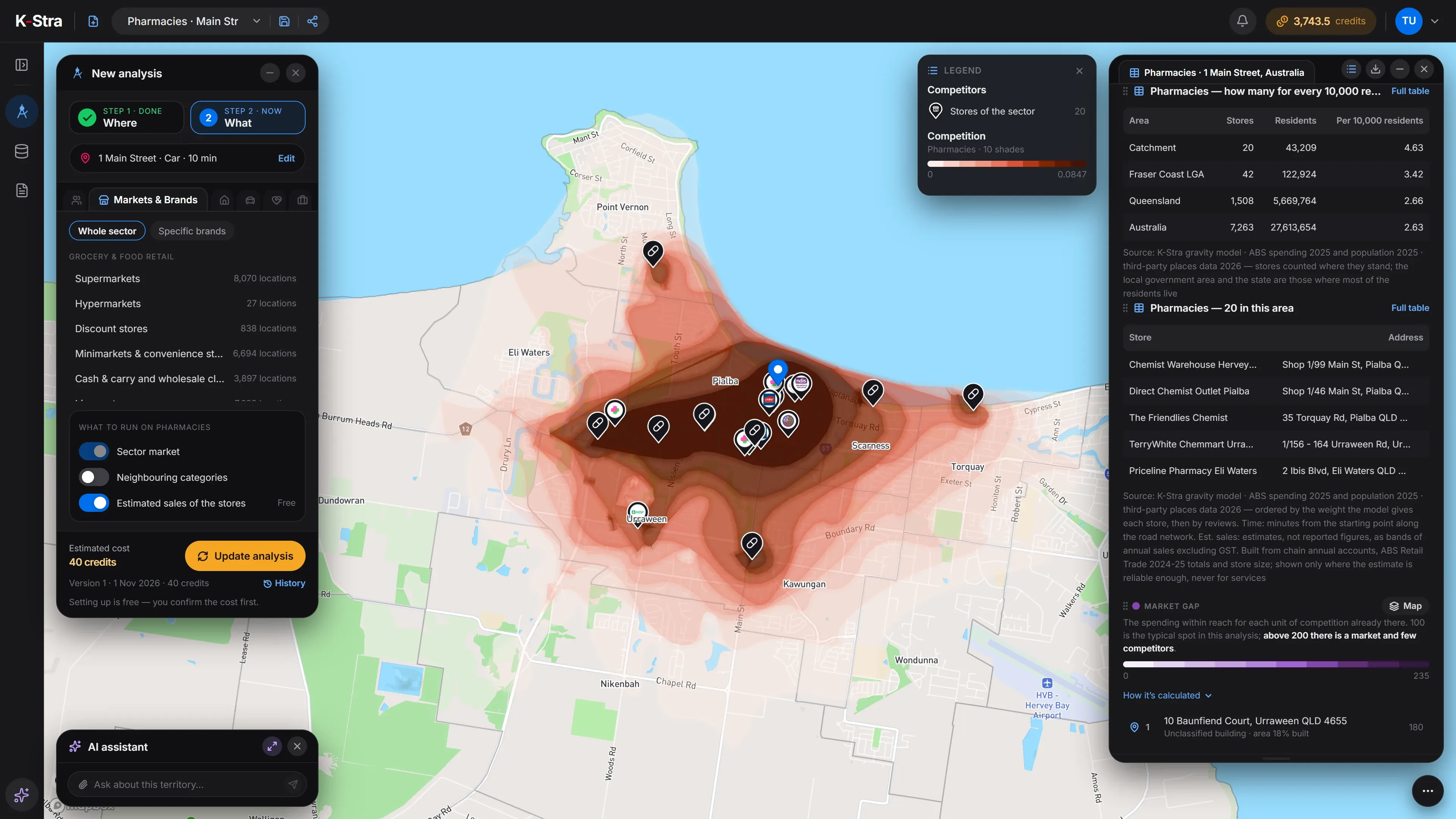
How do you analyse a pharmacy site in K-Stra?
Two analyses of the same area: Markets & Brands with Pharmacies as a whole sector, and People & Economy with Age. Each shows its price before it runs.
- WhereThe address and a 10-minute drive. The size of the area does not change the price of either analysis.
- WhatMarkets & Brands, whole sector, Pharmacies, for 40 credits; then People & Economy, Age, for 2.
- ReadDemand, competition and market gap on the map, every pharmacy in a table, and the age of residents against Australia.
What does a pharmacy analysis show?
Pharmacies within 10 minutes by car of 1 Main Street, Pialba (Hervey Bay) QLD: 20 for 43,209 residents, 4.63 per 10,000 against 2.63 in Australia. 34.9% of those residents are aged 65 or over, twice the Australian 17.5%, and 27.1% are 70 or over against 12.5%. Their average age is 48.5.
| Area | Pharmacies | Residents | Per 10,000 residents |
|---|---|---|---|
| Catchment | 20 | 43,209 | 4.63 |
| Fraser Coast (council) | 42 | 122,924 | 3.42 |
| Queensland | 1,508 | 5,669,764 | 2.66 |
| Australia | 7,263 | 27,613,654 | 2.63 |
Sources: K-Stra analyses of 1 November 2026: pharmacies, and the age of residents, within a 10-minute drive in average traffic of 1 Main Street, Pialba (Hervey Bay). Stores: K-Stra places catalogue, October 2026. Residents and age: ABS population estimates at 30 June 2025, spread onto addresses by K-Stra.
Does Hervey Bay have too many pharmacies?
The density alone does not say. The catchment has 76% more pharmacies per resident than Australia, and also almost twice its share of people aged 65 and over: 15,092 of them within ten minutes. Older residents use pharmacies more, which may explain part of the difference, but the table cannot say how much; the market gap and the competition map of the same area are where to look. The Fraser Coast council area as a whole sits at 3.42, between the two.
The best-ranked location is near 10 Baunfiend Court, Urraween, with a market gap of 180. Spots in Wondunna, Torquay and Urangan score higher, but the buildings around them are smaller than a pharmacy usually needs, so the app ranks them lower and says why.
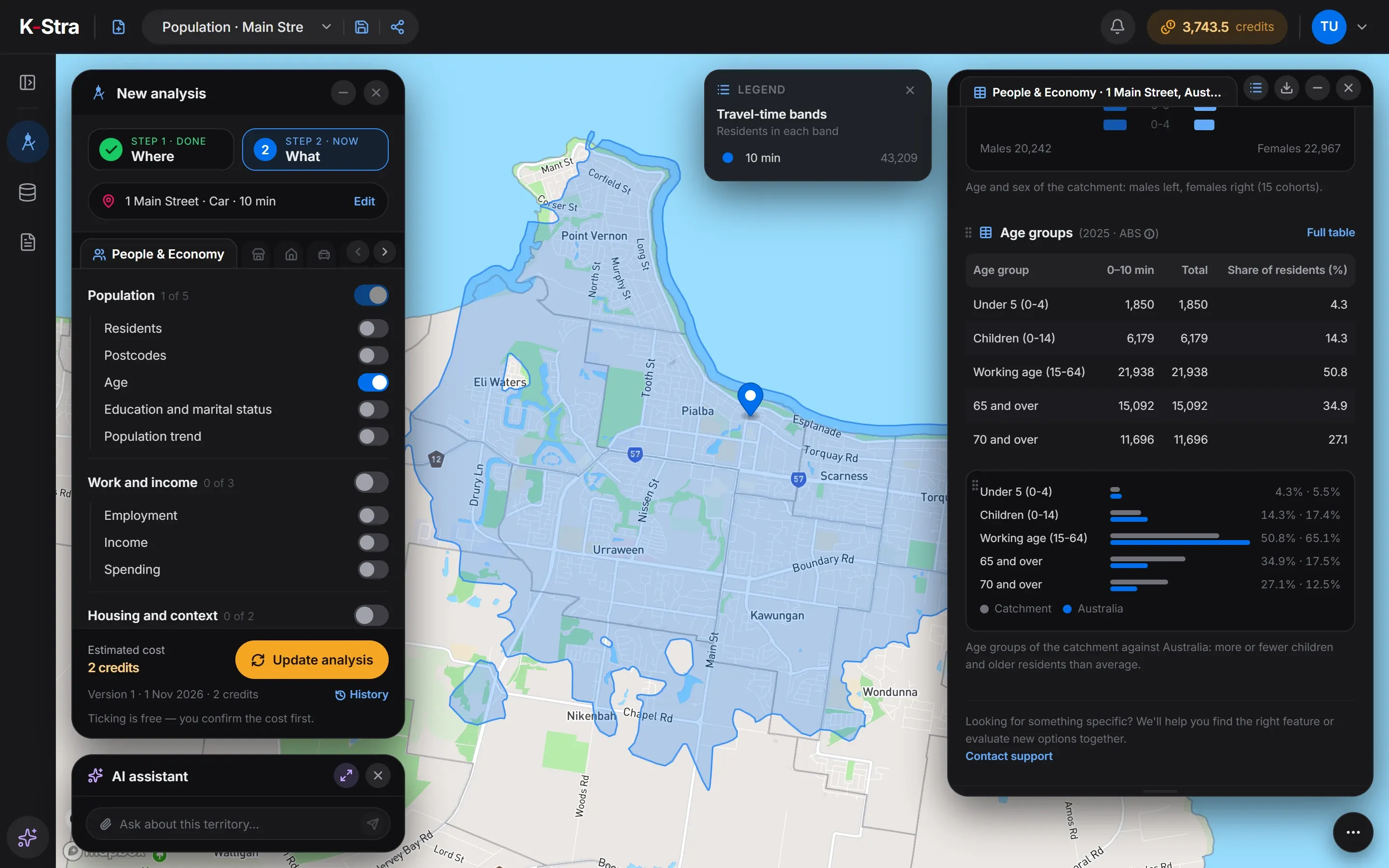 Age · Hervey Bay
Before choosing a site, check it against the Pharmacy Location Rules. Under Item 130, for example, a new pharmacy must be at least 1.5 km in a straight line from the nearest approved pharmacy, among other conditions, and other items set different ones. K-Stra does not assess eligibility.
Source: Australian Government Department of Health, Pharmacy Location Rules – Applicant’s handbook, Item 130, March 2026 edition.
How much does a pharmacy analysis cost?
The Hervey Bay example cost 42 credits. A whole council area would cost the same: you pay for the questions, not the size of the area.
Each other health sector — GPs, dentists, physiotherapy — is another 40 credits, on the same area or a different one.
- Markets & Brands, Pharmaciesper sector, any area40 credits
- People & Economy, Ageper topic2 credits
- Maps, tables and exports of the resultsFree
- Total= 42 credits
- ≈ A$64 at the Single report pack rate of A$1.53 a credit; less with larger packs and monthly plans.
Optional, not in the total
- Compare candidate sitesper candidate site+ 20 credits
The estimate appears before each run starts, and a run that fails costs nothing.
What do people opening a pharmacy ask next?
Who lives within reach of the site?
Age, households, income and spending of the residents, read against the council, the state and Australia.
Demographic analysisWhere do the people of this catchment live?
Draw the catchment in drive time on real roads, see who lives in each band, and how far patients really travel.
Catchment area analysisShould I move my pharmacy?
Compare the current site with the candidates on the same catchment and competitors. Relocations have their own rules, so check them in parallel.
Store relocation
What else do people ask about pharmacy locations?
Does K-Stra check whether a site meets the Pharmacy Location Rules?
No. Approval to supply PBS medicines from a site depends on the Pharmacy Location Rules, assessed by the Australian Community Pharmacy Authority, and most rules use straight-line distances to the nearest approved pharmacy. K-Stra shows where pharmacies are and how long it takes to drive to them; the applicant’s handbook sets out the rules.
How many residents does a pharmacy serve in Australia?
About 3,802 on average: 7,263 pharmacies for 27,613,654 residents, or 2.63 per 10,000. Areas with many older residents support more, as the Hervey Bay example shows with 4.63 per 10,000.
Does K-Stra have health data about the residents?
No. K-Stra has the age and sex of residents, households, income and spending from the ABS, but no data on illness, prescriptions or use of health services. Age is the closest proxy it offers, and the one this page uses.
Can I analyse GPs, dentists or physiotherapists instead of pharmacies?
Yes. General practitioners, dental clinics, physiotherapy centres, polyclinics, optical centres, orthopedic suppliers, parapharmacies and aged care are separate sectors, each with its own demand, competition and market gap. One analysis runs one sector.
Does K-Stra show the estimated annual sales of pharmacies?
Where the model can estimate a pharmacy, as a band with its confidence, never as a figure, and they are estimates, not reported figures; in the Hervey Bay example, run on 1 November 2026, when only high and medium estimates were shown, none of the 20 pharmacies had one. Clinics and other health services never have an estimate, because they are services rather than retail.
See who lives around
your pharmacy.
Type an address, pick Pharmacies and read the residents, the competition and the gaps on one map.
Open the app — free to exploreExploring the map is free; you pay only for the analyses you run