
How can a sales manager split territories fairly between reps?
Territories drawn years ago leave one rep driving all day and another sitting on half the clients. Here is how to redraw them on numbers everyone can check.
A sales manager splits territories fairly by building them from postcodes so that each rep gets a similar share of the measure that drives the work — clients, prospects or residents — within a set tolerance and a reasonable drive from home base, and by checking which areas fall outside every territory or are claimed by two reps.
What does a sales manager need to know about territories?
Are my territories balanced?
Each rep’s share of clients, prospects or residents, the largest gap from the average and the drive involved.
Sales territory mappingWhere are my clients?
Clients by postcode on the map, how far they are from each rep and the areas where they cluster.
Customer mappingWhich areas are untapped?
Residents, businesses and income in areas where you have few clients, to aim prospecting.
Market potential analysis
Why do sales territories go out of balance?
Territories are usually drawn once, around where reps happened to live, and patched every time someone leaves. After a few years one territory holds three times the clients of another, and nobody can say exactly why.
The fair measure depends on the job. Reps who serve existing accounts should share clients; reps who prospect should share the market, which residents or businesses stand for. Balancing the wrong one rewards the wrong people.
Drawing territories by hand on a spreadsheet of postcodes takes days and still leaves gaps. An algorithm that keeps every territory in one piece and inside a drive-time limit does it in seconds, and leaves the manager to adjust what only they know.
What does K-Stra give a sales team?
Balanced territories
Postcodes, suburbs or statistical areas split evenly on the measure you choose, within ±5, ±10 or ±20%.
Sales territory mappingDrive time per rep
The average and longest drive from each rep’s base, and an optional cap of 10 to 60 minutes.
How the engine worksClients and prospects
Clients by rep, prospects by area and the postcodes two reps both claim, from your own files.
Your own dataShare the result
Send the saved analysis by link, or export the list of areas by rep to Excel for the CRM.
Sharing
K-Stra runs on a dedicated server in Sydney: your datasets, your analyses and your results stay in Australia. Map tiles, payments and sign-in never see your files. Three steps can: geocoding sends only the address text, and only after you confirm; the AI assistant reads column names and values when you ask it about a dataset; email notifications carry figures from your analysis.Where your data lives. Mark a dataset “session only” and it is deleted 24 hours after upload.
Transcript
Sales shows how your sales force covers the territory: who leads where, who overlaps, and what nobody follows yet. Load your sellers, your business clients and your prospects — here, a sample team of nine in Sydney. There is no area to draw: the postcodes they work in are the territory. For each postcode you see the leading seller, the clients shared between sellers, and the prospects nobody is following yet. Each seller gets a drive-time catchment, showing the residents reached by one seller, by several, or by nobody. Balanced territories then divides the area among your sellers, by clients or by residents. Exploring and setting up are free. You only spend credits when you run the analysis.
Should territories share clients or residents?
A sample sales team of 9 reps covers Sydney and the Illawarra, NSW, with 5,715 clients spread over 119 postcodes. Balanced on residents, every territory lands within ±10% of the average of 282,123 people; the largest gap falls from 100% to 9.8%.
Balanced on clients, only 4 of the 9 territories make it. One postcode holds about a third of all clients, and no territory made of whole postcodes can split it. The rep-by-rep result is on the sales territory mapping page.
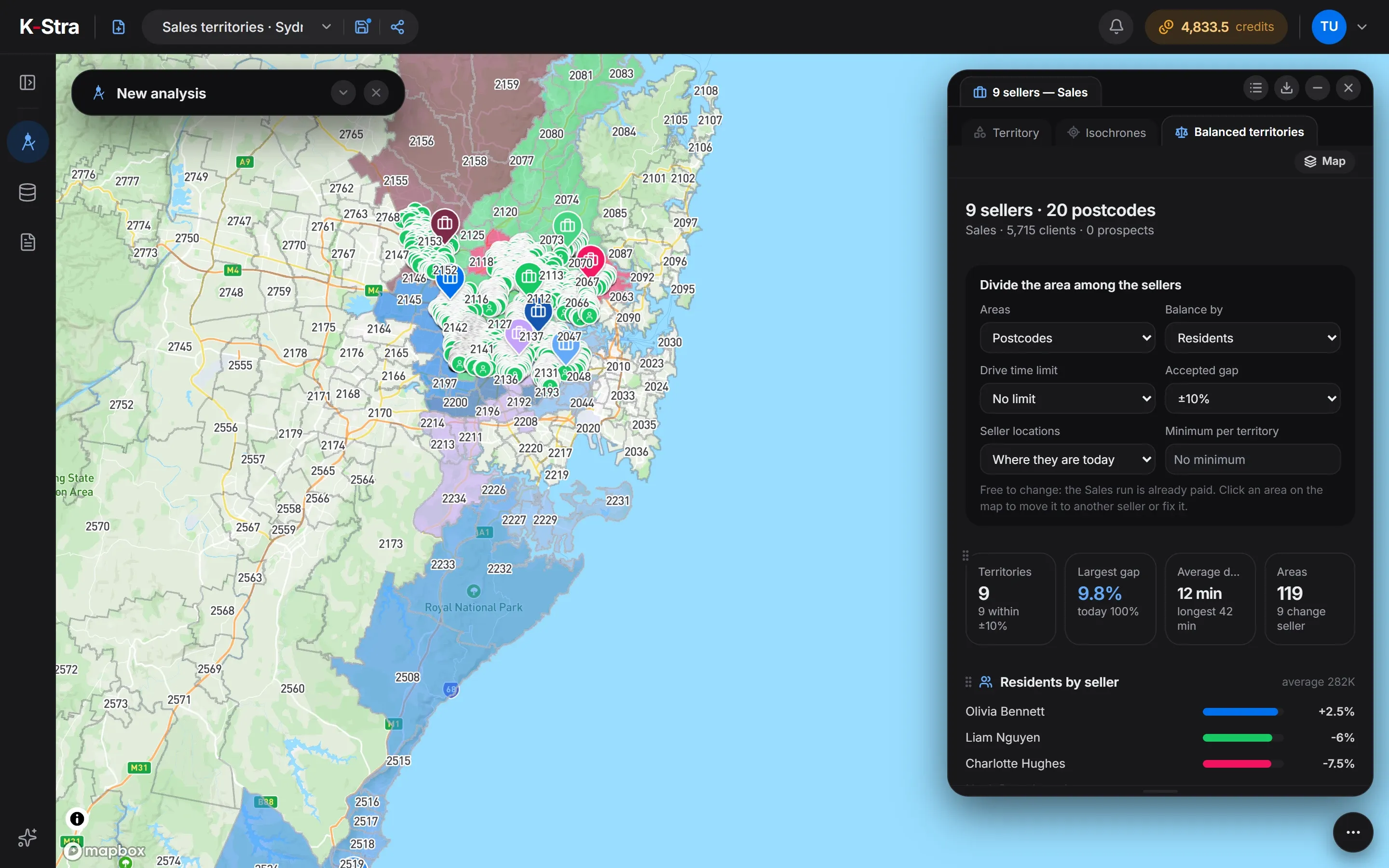 Territories · Sydney
What changes when you balance on clients instead of residents?
The same 9 sample reps and 119 postcodes, balanced twice with a tolerance of ±10%. “Today” is the largest gap with territories as they were drawn before.
| Measure | Within ±10% | Largest gap | Largest gap today | Average drive | Longest drive |
|---|---|---|---|---|---|
| Residents | 9 of 9 | 9.8% | 100% | 12 min | 42 min |
| Clients | 4 of 9 | 231.5% | 263.1% | 8 min | 36 min |
Sources: 9 fictional reps and 5,715 fictional clients in a K-Stra sample account; residents from ABS population estimates at 30 June 2025, postcodes as ABS Postal Areas. Balanced territories in K-Stra, 31 October 2026.
Which balance should this team choose?
If the reps mainly look after accounts, clients are the right measure, and the result says something useful: the concentration in one postcode is a key-account problem, not a territory problem. That area needs its own owner.
If the reps prospect, residents are the fairer yardstick, and here the balance is almost perfect with an average drive of 12 minutes. Many teams use both: residents for the borders, clients to decide who gets the big accounts.
How much does it cost to redraw sales territories?
Once the analysis exists, trying another measure, tolerance or drive-time limit costs nothing: the team above was balanced on residents and on clients for the same 45 credits.
- Sales territories, 9 reps5 credits per sales rep45 credits
- Clients and prospectsFree
- Rebalancing, manual moves, drive-time capsFree
- These territories= 45 credits
- ≈ A$69 at the Single report pack rate of A$1.53 a credit; less with larger packs and monthly plans.
Optional, not in the total
- Client file import1 credit per 10,000 rows+ 1 credit
The cost appears before the run starts, and a run that fails costs nothing.
What else do sales managers ask?
What do I need to load to draw sales territories?
A list of your reps with the address they start from, and if you have them, your clients and prospects with their postcode. Templates are provided. Business clients are best loaded without the names of people.
Can K-Stra plan visit routes or calendars?
No. It draws territories and shows who covers what; it does not plan routes, schedule visits or project sales. Those stay in your CRM or routing tool.
Can I move an area from one rep to another by hand?
Yes. Move an area to another rep, fix it in place, and let the rest balance again around your choices, with Undo at every step. Each territory stays in one piece.
How many reps can one analysis hold?
Up to 100 reps, each with a single territory, at 5 credits a rep. Clients and prospects cost nothing, and rebalancing after the first run is free.
Can I balance on the value of each client?
Yes, if your client file has a column for it, such as yearly orders: territories can balance the sum of any numeric column of your clients, as well as clients, prospects, residents or families.
Give every rep
a fair territory.
Load your reps and clients, choose what to balance and see the territories in seconds.
Open the app — free to exploreSales territories 5 credits per rep, after you confirm the estimate