
How do I divide an area fairly between sales reps?
Territories drift: clients move, reps leave, a new suburb fills up. Here is how to redraw them on numbers, and what changes depending on what you choose to balance.
A fair sales territory gives each rep a similar amount of work or potential within a reasonable drive. Build territories from small areas such as postcodes, decide what to balance — clients, prospects, residents or a value from your own records — keep each territory in one piece, and compare the result with how the area is split today.
Why is it hard to split an area fairly?
Territories are usually drawn once and then patched. A rep inherits the postcodes of whoever held the job before, and the gap between the busiest and the quietest patch grows without anyone measuring it.
Equal is also less obvious than it sounds. A territory can be fair in clients and badly unbalanced in potential, or the other way round, and the two goals often pull the borders in opposite directions.
Then there is geography. Postcodes come in whole pieces, so one busy postcode can be bigger than a fair share on its own; rivers and motorways stretch drive times; and a rep based far from the clients cannot get a fair share without driving across someone else’s patch.
Operations researchers have studied the problem since the 1960s, when the same models were first used to redraw electoral districts. The criteria they settled on are still the ones to check: balance, compactness and territories in one piece.
sales territory alignments at about 500 companies, reviewed over thirty years by Zoltners and Sinha: travel time on the road network and the disruption to existing clients became part of the models.
Zoltners, A.A. and Sinha, P. (2005), “Sales territory design: thirty years of modeling and implementation”, Marketing Science 24(3), 313–331.
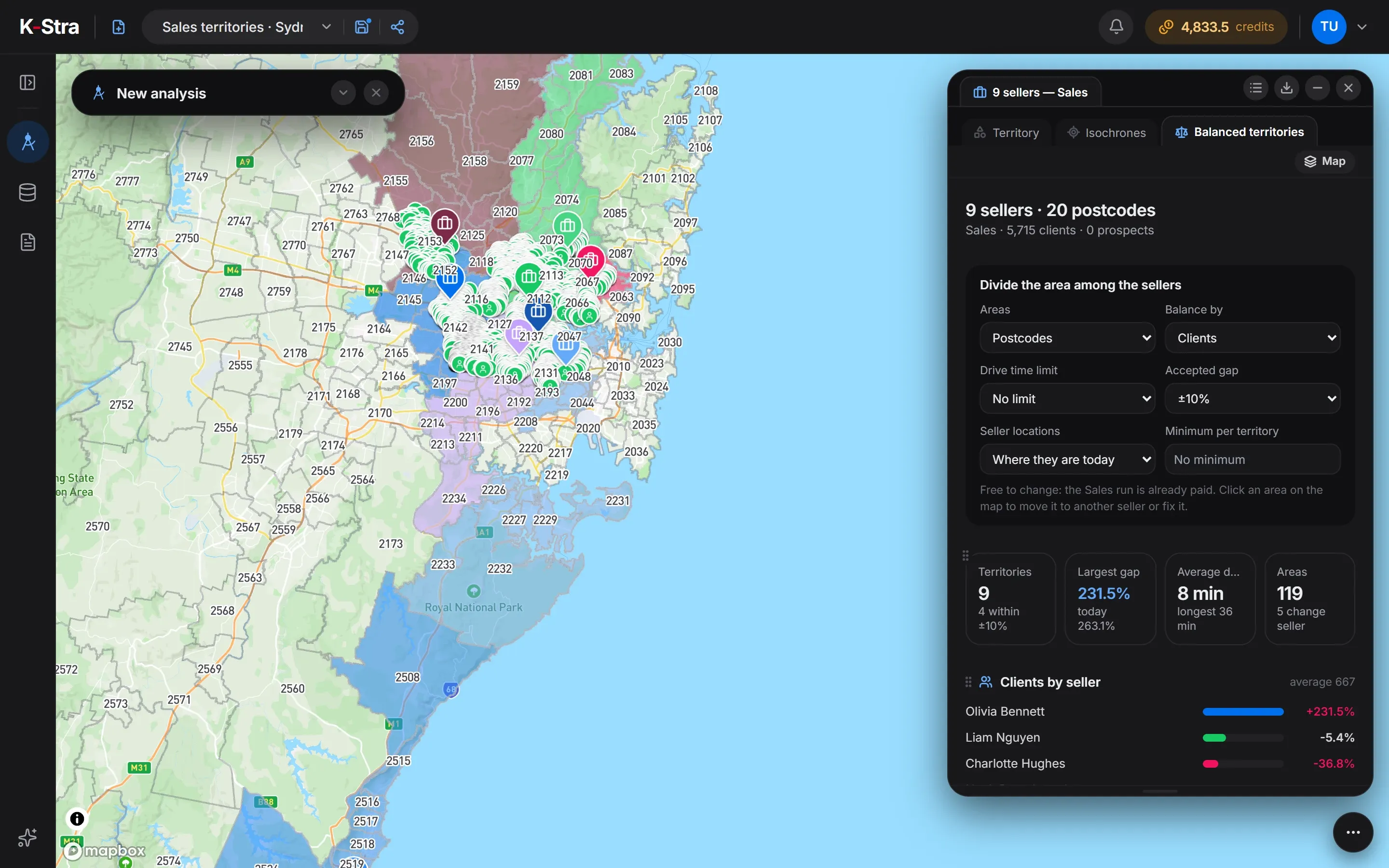 Balanced on clients
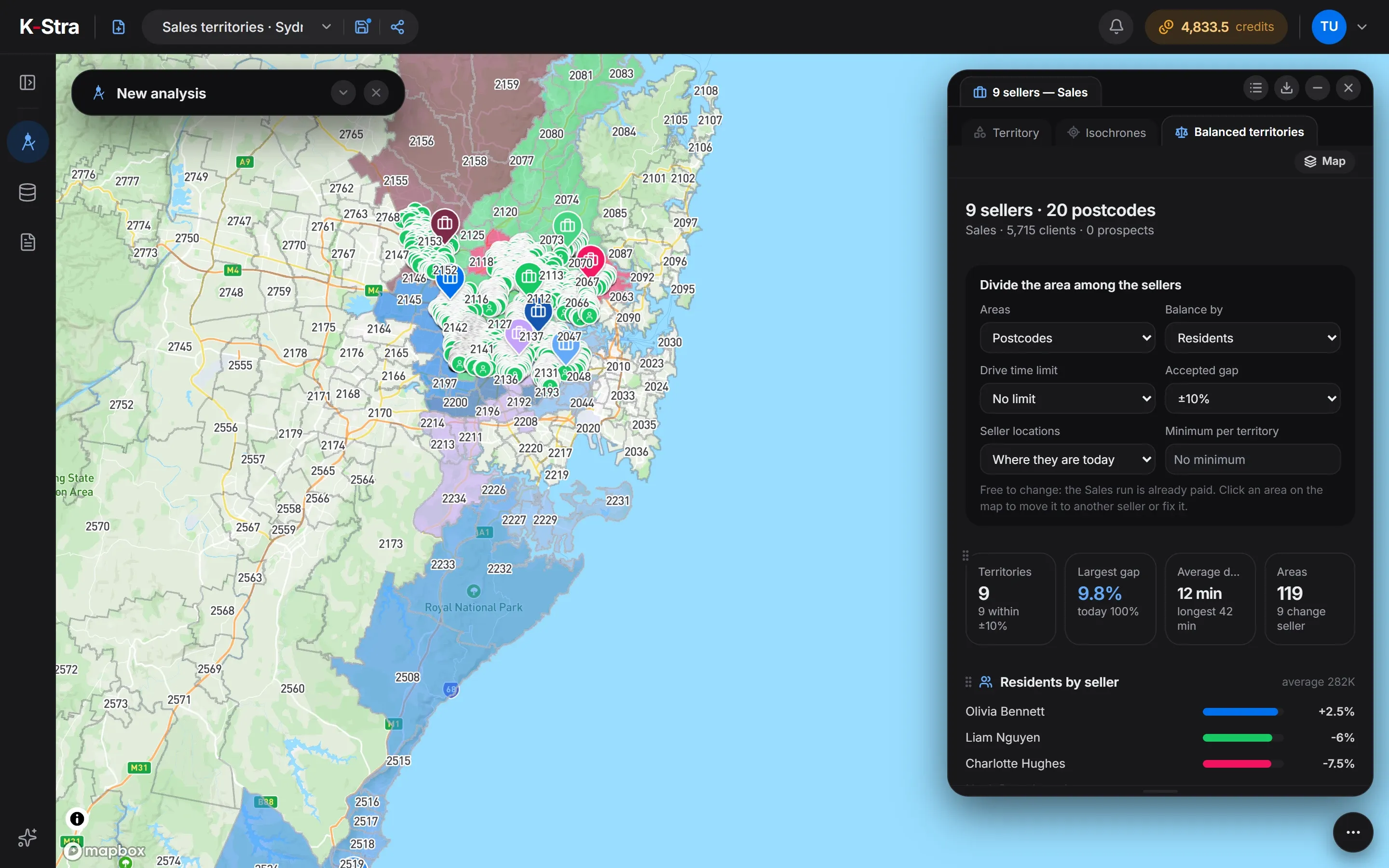 Balanced on residents
How do you balance sales territories, step by step?
Pick the building blocks
Territories are made of small areas that never split: postcodes, suburbs or statistical areas. Smaller blocks give finer borders; postcodes are what most teams already use.
Decide what has to be equal
Workload is measured in clients to visit; opportunity in prospects, residents, families or a value such as last year’s revenue. One measure leads, the others are checked afterwards.
Start from where reps are
Each rep is based at a home or an office. Territories grow outwards from that base, so the drive stays reasonable.
Set a tolerance
Perfect equality is rarely possible with whole postcodes. A band such as ±10% around the average is a realistic target.
Keep territories in one piece
A territory split in two forces a rep to drive across someone else’s patch. Contiguity and a maximum drive time keep the map workable.
Fix what must not move
Key accounts and long relationships stay with their rep. Lock those areas first, then let the rest balance around them.
Compare with today
Measure the largest gap before and after, and count the areas that change hands: every move disturbs a client relationship.
What data do you need to map sales territories?
Your own lists do most of the work: where the reps are and where the clients are. Population and boundaries come with K-Stra.
Your sales reps
One row per rep with a code and an address or coordinates. A rep who works from up to ten bases can have one row for each.
How My Data worksClients and prospects
Optional but decisive: a postcode or the address of a business, the code of the rep who serves them and any value you want to balance, such as revenue or orders. No names or private home addresses.
How My Data worksPostcodes and suburbs
In the 2021 edition of the ABS standard (ASGS Edition 3), which K-Stra uses, Australia has 2,643 postal areas and 15,352 suburbs and localities; Edition 4, of July 2026, has 2,644 and 15,376. Postal areas approximate postcodes and can cross state borders.
ABS boundariesResidents and families
To balance potential rather than workload: ABS population estimates at 30 June 2025, counted address by address inside each area.
See the data
K-Stra runs on a dedicated server in Sydney: your datasets, your analyses and your results stay in Australia. Map tiles, payments and sign-in never see your files. Three steps can: geocoding sends only the address text, and only after you confirm; the AI assistant reads column names and values when you ask it about a dataset; email notifications carry figures from your analysis.Where your data lives. Mark a dataset “session only” and it is deleted 24 hours after upload.
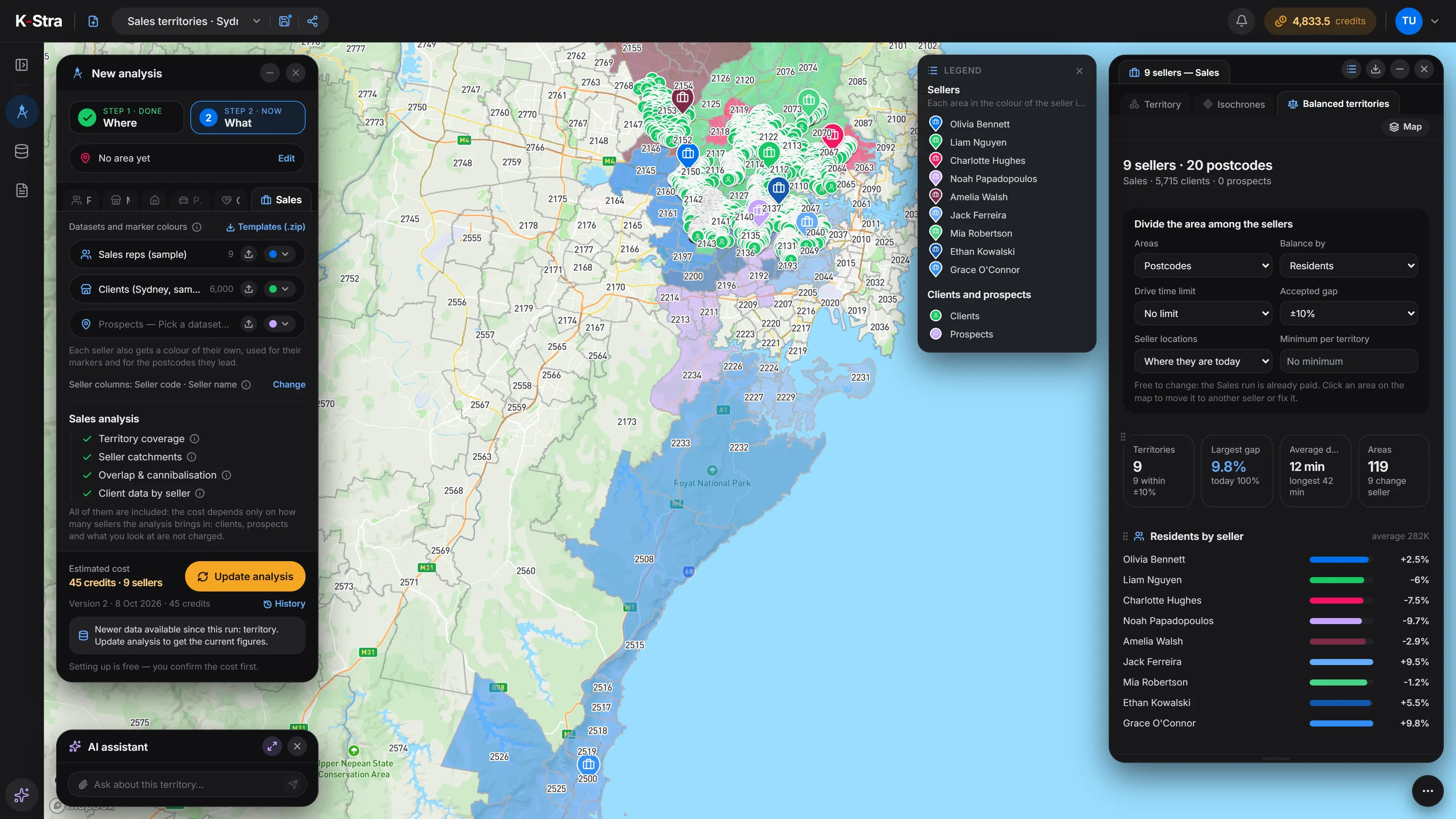
How do you balance territories in K-Stra?
Sales is a module of the What step. You bring your reps and clients from My Data; once the analysis has run, three tabs read the same data in three ways.
- TerritoryEach postcode in the colour of the rep with the most clients there, with tables of clients by rep and the clients two reps share.
- IsochronesA drive-time catchment around each rep, from 5 to 30 minutes, and the residents reached by one rep, by two or more, or by none.
- Balanced territoriesChoose the areas and what to balance, set a drive limit and a tolerance, then move or fix areas on the map. Every change recalculates for free.
The result is the same every time for the same settings, so a proposal can be reopened and discussed. With proposed sites, K-Stra suggests one base per rep where the split would be most even, and pairs each base with the nearest rep.
What does balancing look like in the app?
On-screen text
Sales · Balanced territories. Divide the area fairly among your sellers. Nine sample sellers and their sample clients, Sydney. Balanced on clients: largest gap 231.5%. Balance on residents instead, ±10%. 9 of 9 territories within ±10%. Every postcode in its seller’s colour. Click an area to move it by hand. The rest rebalances: still 9 of 9 within ±10%. Postcodes, suburbs, SA areas or LGAs. Territories that are fair by the numbers. Sellers and clients in this clip are sample data. Residents: ABS estimates.
What does a balanced split look like?
9 sample reps in Sydney and the Illawarra, NSW, 119 postcodes, balanced on residents with a tolerance of ±10% and no drive limit. Today the largest gap is 100%: one rep has no territory at all. After balancing it is 9.8%, with an average drive of 12 minutes and the longest at 42.
| Rep | Postcodes | Residents | Gap from average | Average drive (min) |
|---|---|---|---|---|
| Olivia Bennett | 9 | 289,286 | +2.5% | 9.1 |
| Liam Nguyen | 12 | 265,091 | −6% | 10.2 |
| Charlotte Hughes | 11 | 260,887 | −7.5% | 10.5 |
| Noah Papadopoulos | 14 | 254,681 | −9.7% | 14.6 |
| Amelia Walsh | 9 | 274,075 | −2.9% | 12.8 |
| Jack Ferreira | 19 | 308,856 | +9.5% | 14.2 |
| Mia Robertson | 17 | 278,699 | −1.2% | 11.2 |
| Ethan Kowalski | 11 | 297,731 | +5.5% | 13.5 |
| Grace O’Connor | 17 | 309,804 | +9.8% | 14.0 |
| Total | 119 | 2,539,110 | — | — |
Sources: Nine fictional sales reps and 5,715 fictional clients in a K-Stra sample account. Residents: ABS Estimated Resident Population at 30 June 2025, spread onto addresses by K-Stra; postcodes as ABS Postal Areas. Balanced territories in K-Stra, 31 October 2026.
How much does a territory analysis cost?
The price depends only on the number of reps: 5 credits per rep, up to 100 reps per run. Clients and prospects are free, whether you have fifty or five thousand.
Balancing is part of the run you already paid for. Try every combination of areas, measure, tolerance and drive limit; nothing is charged again until you run a new sales analysis with a different team.
- Sales analysis, 9 reps5 credits per sales rep45 credits
- Clients and prospectsFree
- Isochrones and balanced territories, as often as you likeFree
- Total= 45 credits
- ≈ A$69 at the Single report pack rate of A$1.53 a credit; less with larger packs and monthly plans.
The estimate appears before anything runs; a run that fails is not charged.
What else do people ask about sales territories?
Which areas should I use: postcodes, suburbs or SA2?
Postcodes are the usual choice because clients, sales records and reps already speak in postcodes. Suburbs give finer borders in cities; SA2 and SA3 areas suit larger regional territories. In K-Stra you can also use SA1 blocks and councils, up to 2,000 areas in one balancing.
Can I balance on revenue instead of the number of clients?
Yes, if the value is in your client file. Any numeric column of your clients — revenue, orders, fleet size — can be the measure, and K-Stra adds it up area by area. Without that column there is nothing to balance on, so the option does not appear.
Can I choose how many territories I want?
There is one territory per rep. With a minimum per territory, the area is divided again until every territory reaches it, and the reps left without one are listed. To test a different team size, add or remove reps in your file.
Does K-Stra plan visit routes or call schedules?
No. It draws territories and measures drive times from each rep’s base to the areas they cover. Daily routes, calendars and call frequencies belong to your CRM or route-planning tool.
What happens to an area I move by hand?
Click an area on the map to move it to another rep or fix it where it is; fixed areas stay put when the rest is balanced again, and Undo takes back the last change. Your choices are saved with the analysis.
Does balancing cost more credits each time?
No. You pay 5 credits per rep once, when the sales analysis runs. Changing the measure, the tolerance, the drive limit or the areas afterwards is free, as many times as you like.
Upload your reps
and see the gap.
Start from the sales templates in the app, run the analysis once and try every way of splitting the area.
Open the app — free to exploreRebalancing after the run is free