
How do you analyse foot traffic before choosing a retail site?
The street matters as much as the suburb. Compare the people and the cars passing each candidate site, at the hours that count, before you sign.
A foot traffic analysis compares how many people and vehicles pass each candidate street at the hours the store will be open, then reads that next to who lives within reach and who already competes there. Passing traffic is not customers, but a store on a quiet street has to draw them from further away.
Why is foot traffic hard to judge from a site visit?
A visit sees one hour of one day. A strip that looks busy at Friday lunchtime can be empty on a Tuesday morning, and the hours that matter depend on what the store sells.
Foot traffic also changes sharply from one street to the next. Within the same short walk, a few streets carry most of the people, while the lane around the corner carries almost none.
And the people passing are not all customers. Commuters hurrying to a station may do less for a café than a quieter street of residents who stop on the way home.
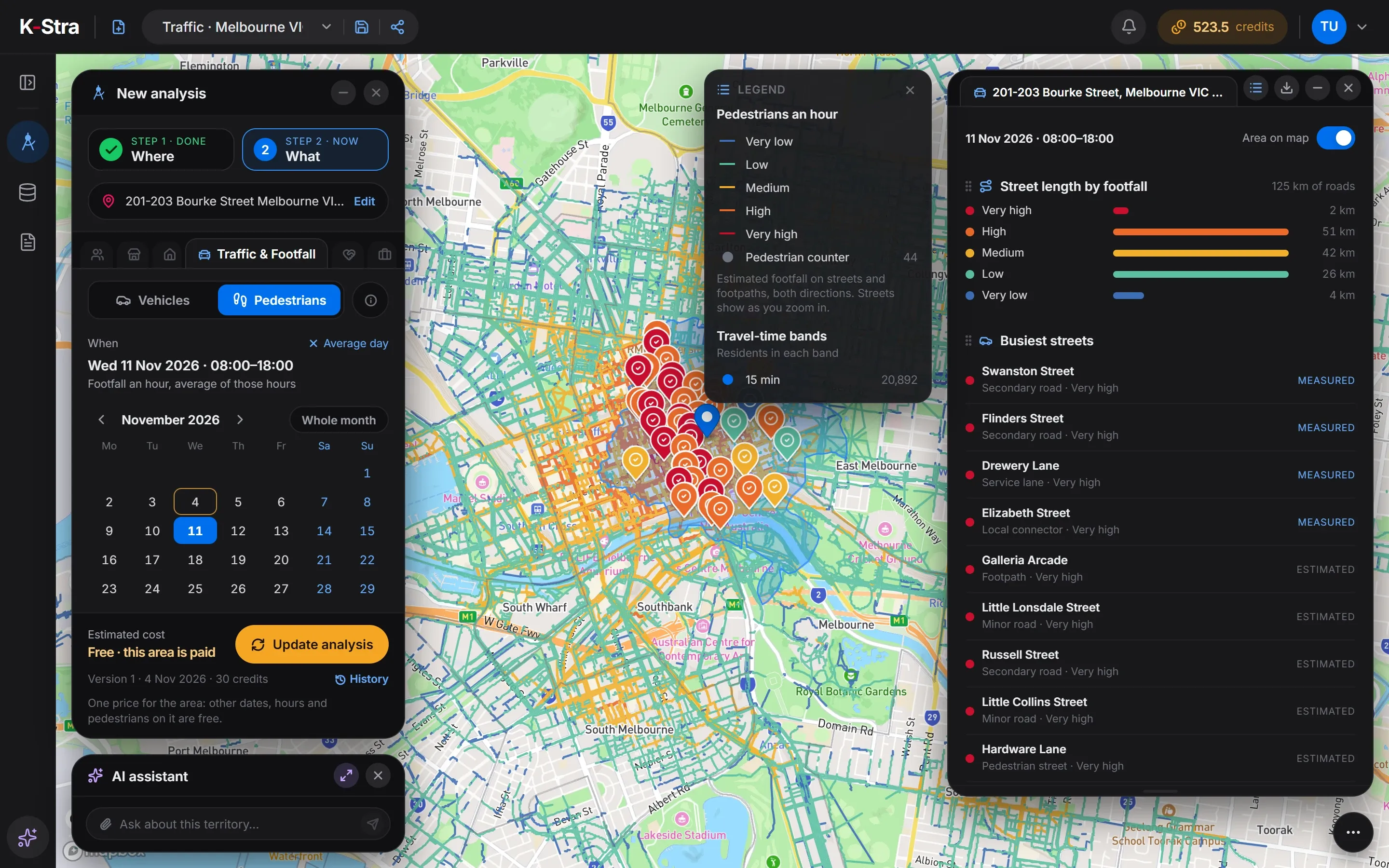
of 125 km of streets within 15 minutes on foot of 201-203 Bourke Street, Melbourne reach the top grade of foot traffic on Wednesday 11 November 2026, 08:00–18:00; 53 km are high or very high.
K-Stra analysis of 4 November 2026
How do you compare foot traffic between candidate sites, step by step?
Decide how customers arrive
On foot, by car or both. A café lives on the people walking past; a bulky-goods store on the cars passing and on parking.
Pick the hours that matter
The days and hours the store will make its week: weekday mornings for coffee, Saturdays for fashion, evenings for food.
Compare streets, not suburbs
Read the foot traffic or the vehicles on each candidate street at those hours, and on the streets around it.
Put the residents beside it
Count who lives within a short walk or drive. Passing traffic and residents together say who a store can reach.
Count the competition on the same streets
A busy street with ten cafés splits its passers-by ten ways; a slightly quieter one with none may serve a store better.
Check the shortlist on site
Stand on the shortlisted streets at the same hours and count for a while. The estimate says where to look; a count on the day confirms it.
What data does a foot traffic analysis need?
Passing traffic says who goes by; the other three say who could come and who else is waiting for them.
Foot traffic on every street
Five grades, from very low to very high, on streets, footpaths and pedestrian ways, calibrated on pedestrian counters in Melbourne, Brisbane, Casey and Sydney.
Traffic & FootfallVehicles on every road
Seven bands of vehicles a day, both directions, calibrated on official counts in 5 states; the counts themselves shown as measured, with their year.
Traffic count dataResidents within reach
ABS population estimates at 30 June 2025, counted address by address inside a walk or a drive from the site.
Catchment area analysisBusinesses already there
2M+ Australian businesses and stores from public online listings, sorted into sectors, to see who shares the same street.
Competitor analysis
How do you run a foot traffic analysis in K-Stra?
The same six steps, inside the app. The map is free to explore without signing up; reading the traffic of an area takes a free account.
- WhereType the candidate address and draw a walk of a few minutes around it, or a drive for a store that lives on cars.
- WhatRun Traffic & Footfall on pedestrians or vehicles, then choose the days and the hours the store will be open.
- CompareRead the busiest streets, then run People & Economy and Markets & Brands on the same area for residents and competitors.
Once the area is paid, changing the day, the hours or switching between pedestrians and vehicles is free. The step-by-step guide · where traffic counts come from.
What does Traffic & Footfall look like in the app, in under a minute?
Transcript
Traffic & Footfall shows how busy every road is: vehicles a day, and people on foot. Draw or pick an area — here, part of western Sydney with its motorways — and choose vehicles or pedestrians. Every road is coloured in one of seven bands of vehicles a day, estimated from trips on the road network and calibrated on official counts. Where a count was taken, the road is marked as measured. Pedestrians come in five grades, and you can pick a date, a range of days or the hours. One price per area: other days, hours and pedestrians on it cost nothing more. Exploring and setting up are free. You only spend credits when you run the analysis.
Which streets near 201 Bourke Street, Melbourne, carry the most people on foot?
Within 15 minutes on foot of 201-203 Bourke Street, Melbourne, on Wednesday 11 November 2026, 08:00–18:00, nine streets reach the top grade. Four are measured by council counters; five have no counter and are estimated, including an arcade and a lane that a visit at the wrong hour could miss.
| Street | Foot traffic | Source |
|---|---|---|
| Swanston Street | Very high | Measured by a counter |
| Flinders Street | Very high | Measured by a counter |
| Drewery Lane | Very high | Measured by a counter |
| Elizabeth Street | Very high | Measured by a counter |
| Galleria Arcade | Very high | Estimated |
| Little Lonsdale Street | Very high | Estimated |
| Russell Street | Very high | Estimated |
| Little Collins Street | Very high | Estimated |
| Hardware Lane | Very high | Estimated |
Source: K-Stra analysis of 4 November 2026; K-Stra foot traffic estimates and 44 pedestrian counters inside the area.
What does the Melbourne example say about choosing a site?
Inside the same 15-minute walk, only 2 km of 125 km of streets reach the top grade. Two shopfronts a block apart can sit on very different streets, so the shortlist is a list of streets, not of suburbs.
The same walk holds 20,892 residents, a small number for the crowd on Swanston Street: in a city centre most people on foot are workers and visitors. A store there lives on passing traffic and on the hours of the offices, not on the neighbourhood.
How much does a foot traffic analysis cost?
The 40 credits of a free account cover the foot traffic and the residents of a first area. Map, area dashboards and exports are free.
- Traffic & Footfall on the area30 credits per area, any size30 credits
- Other days, hours, and vehicles or pedestrians on itFree
- Residents within reach (People & Economy, one topic)2 credits per topic2 credits
- Foot traffic and residents of one area= 32 credits
- ≈ A$49 at the Single report pack rate of A$1.53 a credit; less with larger packs and monthly plans. A new free account’s 40 welcome credits cover it.
Optional, not in the total
- Competitors of one sector (Markets & Brands)40 credits per sector+ 40 credits
Before you confirm, the app shows the price and your balance after the run. A failed run charges nothing.
What else do people ask about foot traffic analysis?
How much foot traffic does a café need?
There is no single number: it depends on the price of a coffee, the seats and how many cafés share the street. Compare the candidate streets of the same city at the same hours, and weigh a higher grade of foot traffic against the cafés already there.
Is passing traffic or catchment population more important?
It depends on how customers arrive. Cafés, convenience stores and takeaway food live on passing traffic; supermarkets, gyms and childcare centres depend more on residents within a short drive. In city centres most passers-by are workers and visitors, not residents.
Can I check foot traffic on a street with no counter?
Yes. K-Stra estimates foot traffic on every street, footpath and pedestrian way in Australia, as a grade from very low to very high, from a model of trips on the street network calibrated on pedestrian counters in Melbourne, Brisbane, Casey and Sydney. It does not track phones, and a counter, where there is one, is shown as measured.
How do I compare two streets or two sites?
Draw one area that holds both, or one around each, and read them on the same day and at the same hours. An area costs 30 credits; changing the day, the hours or switching between pedestrians and vehicles on it is then free.
Does foot traffic tell me how many customers a store will get?
No. Foot traffic is the people passing along the street, not walking through the door. It says which streets give a store the most chances to be seen; the residents within reach and the competitors say how many of those chances it can turn into customers.
Choose the street,
not just the suburb.
Draw an area around your candidate sites, choose pedestrians or vehicles and the hours you will open. 30 credits for the area, then other periods are free.
Open the app — free to explore40 credits when you sign up · no card required