
How can a small business owner choose a location without a consultant?
You have one location to choose, a lease of several years to sign and nobody to run the numbers for you. Here is what to check, and what it costs.
A small business owner can check a location without a consultant by measuring who lives within reach of the address, counting the competitors already serving them per 10,000 residents, and comparing that with the council and Australia. With K-Stra this takes one sector analysis, and the free sign-up credits pay for it.
Which questions does a first location have to answer?
Who lives within reach?
Residents, families, age and income within the drive or walk your customers would actually make.
Demographic analysisWho is already there?
Every competitor around the address, with rating, reviews and how many there are per 10,000 residents.
Competitor analysisWhich of my sites is better?
Two to five candidate addresses run through the same model, side by side, before you sign.
Retail site selectionHow far will customers come?
The catchment drawn on the road network in minutes, instead of a circle on a map.
Catchment area analysisIs the market big enough?
What the residents of the area spend each year on what you sell, and how many businesses share it.
Market potential analysisShould I move my shop?
Your current address against the alternatives, on the same numbers, before the lease runs out.
Store relocation
Why is choosing a location on your own so risky?
A first shop is usually the biggest commitment a small business makes: a fit-out paid up front and a lease that outlasts most business plans. A chain spreads that risk over many stores; an owner puts it all on one address.
The usual evidence is a walk down the street at lunchtime and a feeling about the neighbourhood. Both miss what decides a shop’s future: how many people live within the distance they would really travel, and how many businesses already compete for them.
Those numbers exist. The Australian Bureau of Statistics publishes population and spending, and businesses are listed online. What an owner lacks is the time to join them up, address by address, along the roads people actually drive.
That joining up is what K-Stra does. You keep the judgement — the shopfront, the landlord, the feel of the street — and decide it with the numbers in front of you.
Which parts of geomarketing can a small business ignore?
Most geomarketing was invented for chains with hundreds of stores. Network planning, cannibalisation between stores and sales territories solve problems you do not have with one location, and for two or three candidate sites a side-by-side table beats a scoring system.
What you cannot skip is the catchment. Council and suburb figures are easy to find but rarely match the area your customers come from, and the difference can turn a crowded market into an open one, or the other way round.
How do you check competitor density with free data?
Before spending anything, five steps with public data give a first answer to how crowded the market is. The worked example below shows why the last step matters.
Find the population of your council
ABS Data by Region and Census QuickStats give the residents of any council or suburb, free and without an account.
Count your competitors
Search an online map for your type of business in the same area and count the results by hand, removing duplicates and closed shops.
Work out the density
Divide the competitors by the residents and multiply by 10,000: the number of businesses like yours for every 10,000 people.
Compare with a benchmark
Do the same for the state or a similar town. Well above the benchmark means a crowded market or one that serves visitors; well below, room or no demand.
Narrow it to your catchment
A council is not your market. Repeat the count for the streets within the drive or walk your customers make, where the answer can change.
What does K-Stra give a business with one location?
The same engine a national chain uses, set up for one person deciding alone.
Free to explore
The map, catchments, businesses around an address and the dashboard of any area work without an account.
Free trial40 credits to start
A free account, without a card, starts with 40 credits: one complete sector analysis at 40.
PricingBuilt for one person
Working alone, you see no organisation, teams or roles: just your analyses, your data and your credits.
How an analysis worksAsk in your own words
The AI assistant sets up an analysis from a sentence and explains the results, at 0.5 credits an answer.
AI assistant
What does a check on one address show?
Take someone thinking of a gelato shop on Harbour Drive in Coffs Harbour. Within a 10-minute drive of 2 Harbour Drive, Coffs Harbour NSW live 32,407 people, and 4 ice cream shops already serve them: 1.23 per 10,000 residents, against 0.94 in Australia.
K-Stra models ice cream shops on a 5-minute walk. That is how far K-Stra assumes customers usually travel to an ice cream shop when it models demand and competition; the 10-minute drive is the area you chose to look at. The first sets the model, the second sets what is counted. Residents of the area spend about A$65 a head a year on it, A$2.12 million in all, from ABS household spending.
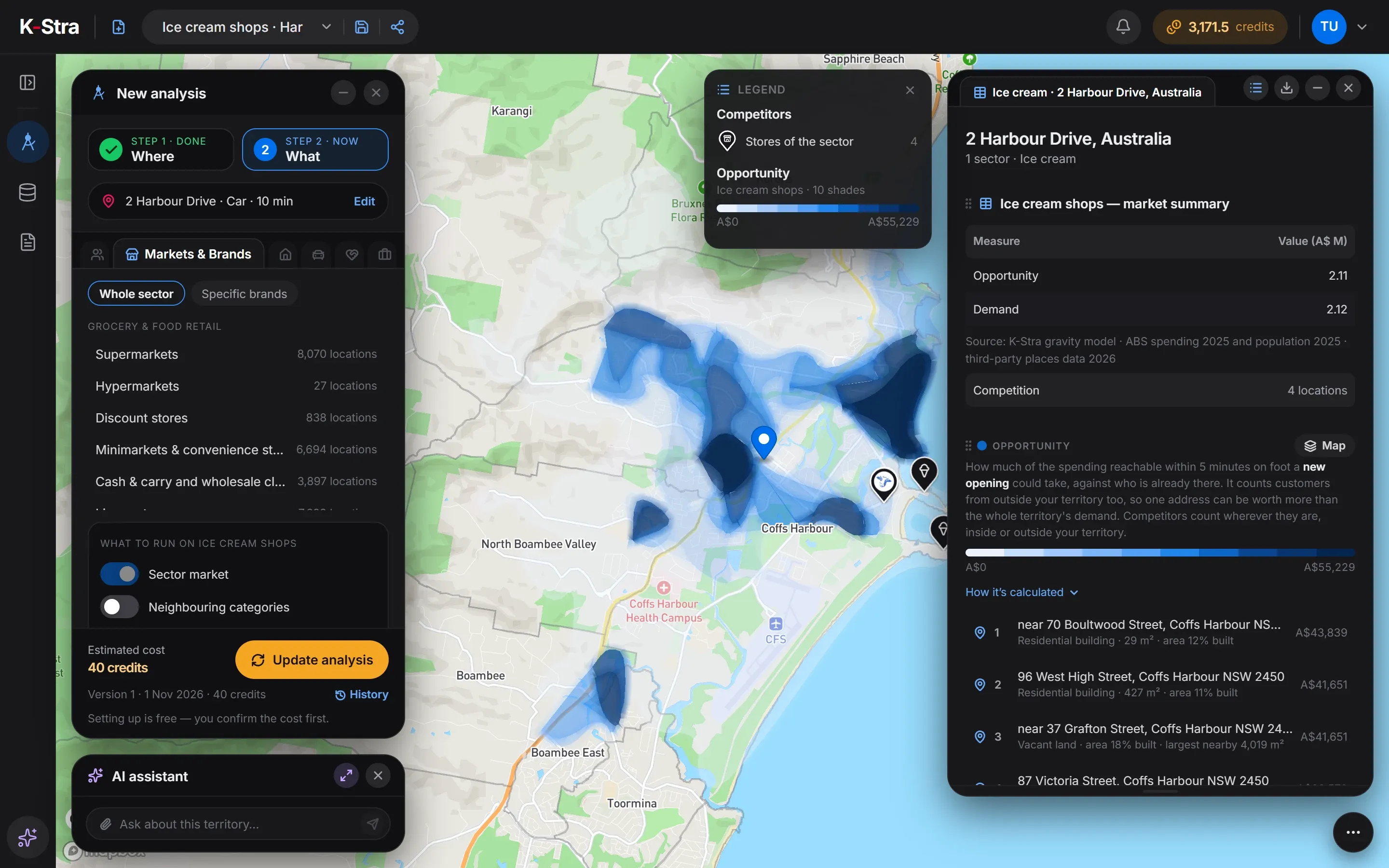 Opportunity · Coffs Harbour
How crowded is the market around the address?
Ice cream shops within 10 minutes by car of 2 Harbour Drive, Coffs Harbour NSW, against the Coffs Harbour council area, New South Wales and Australia. None of the four shows an estimate of annual sales: small independent shops rarely do.
| Area | Ice cream shops | Residents | Per 10,000 residents |
|---|---|---|---|
| Catchment | 4 | 32,407 | 1.23 |
| Coffs Harbour (council) | 8 | 82,109 | 0.97 |
| New South Wales | 763 | 8,592,524 | 0.89 |
| Australia | 2,605 | 27,613,654 | 0.94 |
Sources: K-Stra analysis of 1 November 2026: ice cream shops within a 10-minute drive in average traffic of 2 Harbour Drive, Coffs Harbour. Businesses: K-Stra places catalogue, October 2026. Residents: ABS population estimates at 30 June 2025. Spending: ABS national accounts, 2024–25.
So is there room for one more?
On residents alone the area is already a little above the national count, and all four shops cluster near the water. The model’s best locations lie inland, near 70 Boultwood Street, 96 West High Street, 37 Grafton Street, and the highest market gap is near 15 Orlando Street, at 237 against 100 for the typical spot.
Then comes the owner’s judgement. The jetty draws holidaymakers the model does not count, because it measures what residents spend; for a gelato shop by the water the real market is larger in summer. The numbers say where locals are underserved; the season says where visitors go.
How much does it cost to check a location?
The Coffs Harbour example cost 40 credits: exactly the 40 credits a free account starts with. Comparing two shortlisted addresses afterwards costs 20 credits each.
- Markets & Brands, your type of businessper sector, any area40 credits
- Maps, tables and exports of the resultsFree
- Total= 40 credits
- ≈ A$61 at the Single report pack rate of A$1.53 a credit; less with larger packs and monthly plans. A new free account’s 40 welcome credits cover it.
Optional, not in the total
- People & Economy, one topicper topic+ 2 credits
- Compare candidate sitesper candidate site+ 20 credits
The cost appears before the analysis runs, and an analysis that fails costs nothing.
What else do small business owners ask?
Can I use K-Stra if I have never done a market analysis?
Yes. You type an address, choose how far customers travel and pick your type of business; K-Stra draws the catchment, counts residents and competitors and explains each map in a sentence. The AI assistant can set the analysis up from a plain description of your business.
How much does it cost to check one location?
A sector analysis costs 40 credits, and a free account starts with 40. A profile of the residents costs 2 credits a topic. Looking at the map, the businesses around you and the free dashboard of any area costs nothing.
Do I have to sign up to a subscription?
No subscription is required. You can buy a single pack of credits when you need more, and a free account tops back up to 20 credits every month until you buy one. Credits do expire: packs after 12 months.
Can I show the results to my bank or landlord?
Yes. Tables export to PDF, Excel and CSV, and maps to an image with title, legend and source, all free. You can also send a link to the saved analysis, which opens without an account.
What free data can a small business use?
ABS Census QuickStats and Data by Region for population, age and households; council planning schemes for what a property may be used for; online maps for counting competitors; and the government guide to choosing a business location on business.gov.au.
How do I find out where my customers come from?
Ask for their postcode at the till or online checkout for a month and tally the answers. Twenty postcodes on a map tell you how far people travel and which nearby areas do not know you yet. No names are needed.
What can K-Stra not tell me about a location?
An exact count of the people who walk past the door (foot traffic comes as a grade for each street), what the previous tenant took, or what the landlord will accept. K-Stra counts residents and their spending, so in tourist streets and city centres the market is larger than the model shows. Visit the site at the hours you would trade.
Check the address
before you sign.
Type the address, pick your type of business and see residents, competitors and gaps on one map.
Open the app — free to exploreExploring the map is free; you pay only for the analyses you run