
How do I choose the location for a new store?
A good location is rarely the one that feels busiest. It is the one where enough people with the right spending can reach you more easily than they reach anyone else.
Choose a store location in seven steps: draw the area customers can reach, count who lives there, check their income and spending, map the competitors, find where demand is left unserved, check access and the rules on site, then compare the shortlisted addresses on the same measures. Visit the best two before you sign.
This guide covers the whole method, from the area customers reach to the lease. Once you have a shortlist, the site selection scorecard shows how to weight criteria and compare the sites.
What decides whether a location works?
Seven factors, in the order a decision usually meets them. The first four come from data; the last three only from the street, the council and the lease.
| Factor | What to measure | Where it comes from |
|---|---|---|
| Customers within reach | Residents and families inside a drive or walk time | ABS population estimates and census |
| Spending power | Income and spending per head against the national average | ABS income and national accounts |
| Competitors | How many, how close, and how many per 10,000 residents | A map of the businesses in your sector |
| Unserved demand | Where spending is high and supply is thin | A demand and supply model for the sector |
| Access and visibility | Parking, public transport, corner position, signage | A visit at different hours |
| Rules | Zoning, permitted use, licences and sector-specific rules | The council and the regulator of your sector |
| Costs and lease | Rent, outgoings, fit-out, lease length and options | The agent, the disclosure statement, a lawyer |
Factors adapted from business.gov.au, “Choose your business location”, Australian Government.
How do you choose a store location, step by step?
- 1
Draw the area customers can reach
Start from how people travel to you: a drive time for a destination store, a walk time for a convenience one.
Common mistakeDrawing a circle. Rivers, rail lines and motorways cut a circle into areas nobody crosses.
- 2
Count who lives there
Residents and families in the area, split by travel time, so the close-in core is visible.
Common mistakeUsing the population of the council or the suburb, which says little about the streets within reach.
- 3
Read income and spending
An income index and spending by category show whether people can afford what you sell and already spend on it.
Common mistakeEquating a wealthy area with a good one. High income with no spending in your category is not demand.
- 4
Map the competitors
Every store of your sector in and around the area, how far each is, and the density per 10,000 residents.
Common mistakeCounting only the competitors inside the area. Shoppers cross the border; so do competitors’ customers.
- 5
Find the demand left unserved
Compare the spending that can reach each point with the pull of the stores already there. The gaps are your candidates.
Common mistakeTreating an empty area as an opportunity. Sometimes nobody is there because nobody would come.
- 6
Check access and the rules on site
Visit at opening and closing time, on a weekday and a weekend. Ask the council about permitted use, and check any rules specific to your sector.
Common mistakeSigning before the council confirms the use. A lease does not make a use permitted.
- 7
Compare the shortlist on the same measures
Two to five addresses, the same travel time, the same indicators side by side, then the costs of each.
Common mistakeComparing a site you love with sites you barely looked at. Give every candidate the same treatment.
What does this look like for a new pharmacy?
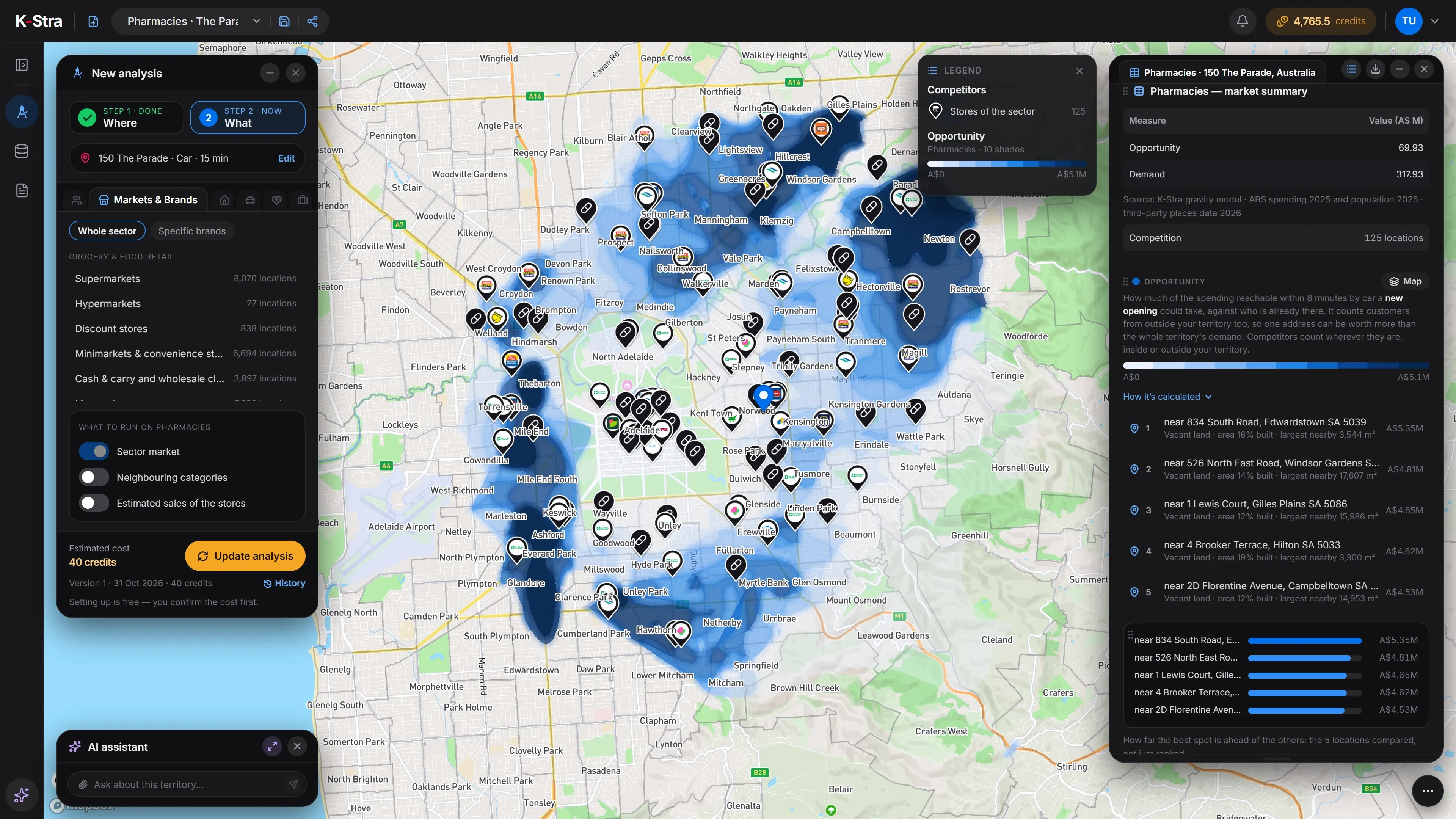 Pharmacies · Adelaide
Within 15 minutes of The Parade live 337,663 people, served by 125 pharmacies: 3.7 for every 10,000 residents, against 3.09 in South Australia and 2.63 in Australia. The area is already well supplied.
The model still finds gaps, mostly on the edges. The strongest is near 834 South Road, Edwardstown, where a new pharmacy could take about A$5.35 million a year of residents’ spending, against the pharmacies already there. It is a modelled share of what residents spend, useful to rank sites; its absolute value is an order of magnitude.
Then the rules come in. A new pharmacy that dispenses PBS medicines must generally stand at least 1.5 km in a straight line from the nearest approved pharmacy, with a full-time doctor and a supermarket within 500 m, or a large supermarket on its own. Every candidate on the list has to pass that test before demand even matters.
Sources: K-Stra analysis of 31 October 2026: pharmacy sector, 15-minute drive in average traffic from 150 The Parade, Norwood. Stores: K-Stra places catalogue, 2026. Residents: ABS Estimated Resident Population at 30 June 2025. Spending: ABS national accounts, 2024–25, in the K-Stra sector model. Rules: Australian Government Department of Health, Pharmacy Location Rules, Item 130 (Applicant’s Handbook, March 2026).
Can I choose a location using only free public data?
Yes, for a single site and with some patience. Public statistics cover the first three steps for any suburb or postcode, a map and a notepad cover the competitors, and the council answers the questions about use.
What is hard by hand is the area itself. Official figures come by suburb and postcode, while a drive time cuts across them, and the unserved demand of step five needs a model. That is where a geomarketing tool saves the most time.
| What you need | Free source |
|---|---|
| Population, ages and households of a suburb or postcode | ABS Census QuickStats and Data by Region |
| A checklist of location factors for a new business | business.gov.au, “Choose your business location” |
| Advice on leases before you sign | Small business commissioners of each state, such as the Victorian one |
| Zoning and permitted use of a property | The planning scheme of the council |
| Competitors near a site | Any online map, a search for your sector and a count by hand |
How do you choose a location in K-Stra?
Steps 1 and 2
Type an address and keep the drive-time bands, or draw the area. Drawing the bands and opening the area dashboards are free.
Steps 3 to 5
People & Economy for income and spending; Markets & Brands, whole sector, for competitors, demand, opportunity and the five best locations.
Step 7
Compare up to five candidate sites on how much residents’ spending each would capture, and from whom. Step 6 stays yours: the visit and the council.
The commercial guide to the same process, with a worked comparison of four sites, is on the retail site selection page.
On-screen text
Where · What · Evaluate & decide. Where to open the next pharmacy. Adelaide, 10 minutes by car from Unley Road. 1 · Where: an address and a 10-minute drive. 2 · What: the pharmacy sector. 3 · Evaluate: the five best locations. Compare sites: keep three candidates. Each site with its own catchment. Ranked by net new spend: A$5.13M a year. Choose the location with the numbers. Spend from the K-Stra gravity model of the sector: ABS spending and population 2025, third-party places data 2026.
What else do people ask about choosing a location?
How far should my store be from a competitor?
There is no general distance. What matters is how many residents each store can draw on: compare the number of stores per 10,000 residents in your area with the state and national figures. Some sectors have a legal minimum, such as the 1.5 km rule for new pharmacies.
Is a site with no competitors a good sign?
Only if the demand is there. A gap in supply next to high spending is an opportunity; a gap next to few residents, or behind a barrier people do not cross, usually means the market has already tried and left.
What does a location study cost?
Done by hand with public sources, mostly time. In K-Stra a sector analysis costs 40 credits on any area and comparing candidate sites 20 credits per candidate site; exploring the map and the area dashboards is free.
What can a data analysis not tell me?
Rent, lease terms, the condition of the building, the view from the street, parking at peak times and how the neighbours trade. Those come from the agent, the council and your own visit, which is why the method ends on site.
Should I open where my best store already is?
Close enough to share the brand, far enough not to share the customers. Before deciding, check how much of the new catchment overlaps the existing one: residents counted twice are customers you already have.
Type the address
you are considering.
See who can reach it in 5, 10 and 15 minutes for free, then run your sector when you are ready.
Open the app — free to exploreExploring needs no account