
How do I choose a location for a hair or beauty salon?
A salon lives on clients who come back every few weeks, from close to home. Here is how to count them, and the chairs already competing for them.
Choose a hair or beauty salon location by counting the residents within a short drive, then the salons, barbers and beauty businesses already serving them, per 10,000 residents against the council, the state and Australia. Clients return every few weeks from close to home, so growing suburbs with few salons usually beat a crowded centre.
Which beauty businesses does K-Stra map?
K-Stra splits beauty and wellness into three sectors: hairdressers, beauty centres and wellness and spa. Each has its own share of ABS household spending on personal care and its own reach, and each is analysed on its own.
They are among the densest trades in Australia: there are more hairdressing locations than pharmacies and supermarkets put together. That is why the count per resident, and where it thins out, matters more here than in most sectors.
| Sector in the app | Locations | What it counts |
|---|---|---|
| Hairdressers | 25,704 | Hair salons, hairdressers and barber shops. |
| Beauty centers | 21,884 | Beauty salons, nail, brow and lash studios, skin clinics. |
| Wellness & spa | 13,748 | Day spas, massage and wellness centres. |
Source: the Beauty & Wellness group in the sector list of the K-Stra app on 1 November 2026, with the names the app uses; business catalogue of 23 October 2026, built from public online business listings. The counts here are the whole catalogue, as on the Australia pages; the national figure in the per 10,000 table of the example below counts only the locations K-Stra can place on an Australian address, so it can be a few places lower, which moves its rate by at most a hundredth.
Which numbers matter most for a salon?
Residents within a short drive
The K-Stra model measures hairdressing on a 6-minute drive, shorter than the 10 minutes it uses for supermarkets. Clients choose a salon near home and rarely cross town for a regular cut. The 6-minute drive is how far K-Stra assumes clients usually travel to a salon when it models demand and competition; the 10-minute drive of the example is the area chosen to look at. The first sets the model, the second sets what is counted.
In the app: the Where step and the Demand map, which counts the spending reachable from each point.
Salons per 10,000 residents
Australia has 9.31. Town centres sit above it; new suburbs often sit far below it for years, until salons follow the houses.
In the app: the density table: catchment, council, state and Australia side by side.
Spending on personal care
Residents of the Rockhampton example spend about A$356 a head a year on what hairdressers sell, from ABS household spending for 2024–25.
In the app: the Demand map and its table of resident spending by band.
The mix of salons, barbers and clinics
A barber, a colour studio and a beauty clinic compete only in part. The category of each listing shows which part of the market is crowded.
In the app: the store table, with categories, ratings and reviews.
Market gap in growing suburbs
Where spending within reach is high against the salons already there, the market gap rises above 100. It is usually highest where new houses arrived first.
In the app: the Market gap map and the five best locations at least 500 m apart.
What data do you need to assess a salon site?
Salons, residents and spending on personal care, already loaded. Nothing needs uploading.
Every salon and barber
25,704 hairdressing locations and two more beauty sectors, with category, rating and reviews, from public online business listings.
Business and competition dataResidents by age
ABS population estimates at 30 June 2025, spread address by address, with the age profile in People & Economy.
Population dataSpending on personal care
Household spending from the ABS national accounts for 2024–25, assigned to each beauty sector.
Work, income and spendingDrive times on real roads
Catchments in minutes along the road network, with or without motorways, or on foot.
How the engine works
How do you analyse a salon site in K-Stra?
Type the address, keep a 10-minute drive, open Markets & Brands and pick Hairdressers — or Beauty centers, or Wellness & spa — as a whole sector.
- WhereThe address and a drive time. The size of the area does not change the price.
- WhatMarkets & Brands, whole sector, Hairdressers. Add the neighbouring categories for spas, beauty clinics and gyms around the site.
- ReadDemand, competition and market gap on the map, every salon with its category, rating and reviews, and five best locations.
What does a salon analysis show?
Hairdressers within 10 minutes by car of 1 East Street, Rockhampton QLD: 75 salons and barbers for 54,362 residents, 13.8 per 10,000 against 9.31 in Australia. 14 of them stand within two minutes of the starting point, in the centre of Rockhampton.
| Area | Salons | Residents | Per 10,000 residents |
|---|---|---|---|
| Catchment | 75 | 54,362 | 13.80 |
| Rockhampton (council) | 87 | 85,794 | 10.14 |
| Queensland | 5,606 | 5,669,764 | 9.89 |
| Australia | 25,702 | 27,613,654 | 9.31 |
Sources: K-Stra analysis of 1 November 2026: hairdressers, hair salons and barbers within a 10-minute drive in average traffic of 1 East Street, Rockhampton. Businesses: K-Stra places catalogue, October 2026. Residents: ABS population estimates at 30 June 2025. Spending: ABS national accounts, 2024–25.
Where is there room for another salon in Rockhampton?
Not in the centre. The catchment has 13.8 salons per 10,000 residents against 10.14 for the Rockhampton council area and 9.89 for Queensland, and many of them sit within a few streets of East Street.
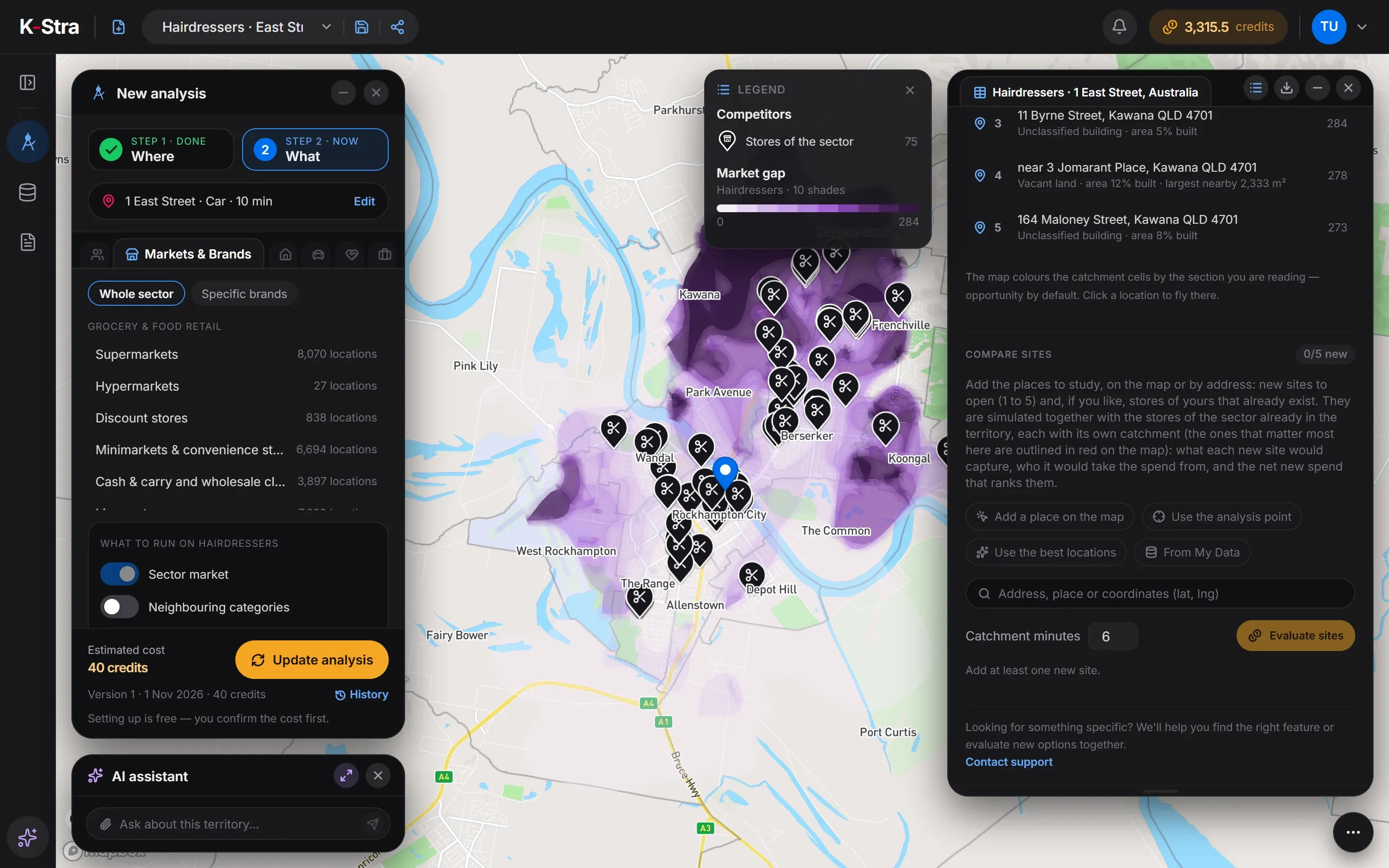
The model points north. The highest market gap is near 591 Ibis Avenue, Norman Gardens, at 332; followed by 605 Yaamba Road, Norman Gardens, at 288; and 11 Byrne Street, Kawana, at 284: suburbs where the residents’ spending meets far fewer chairs.
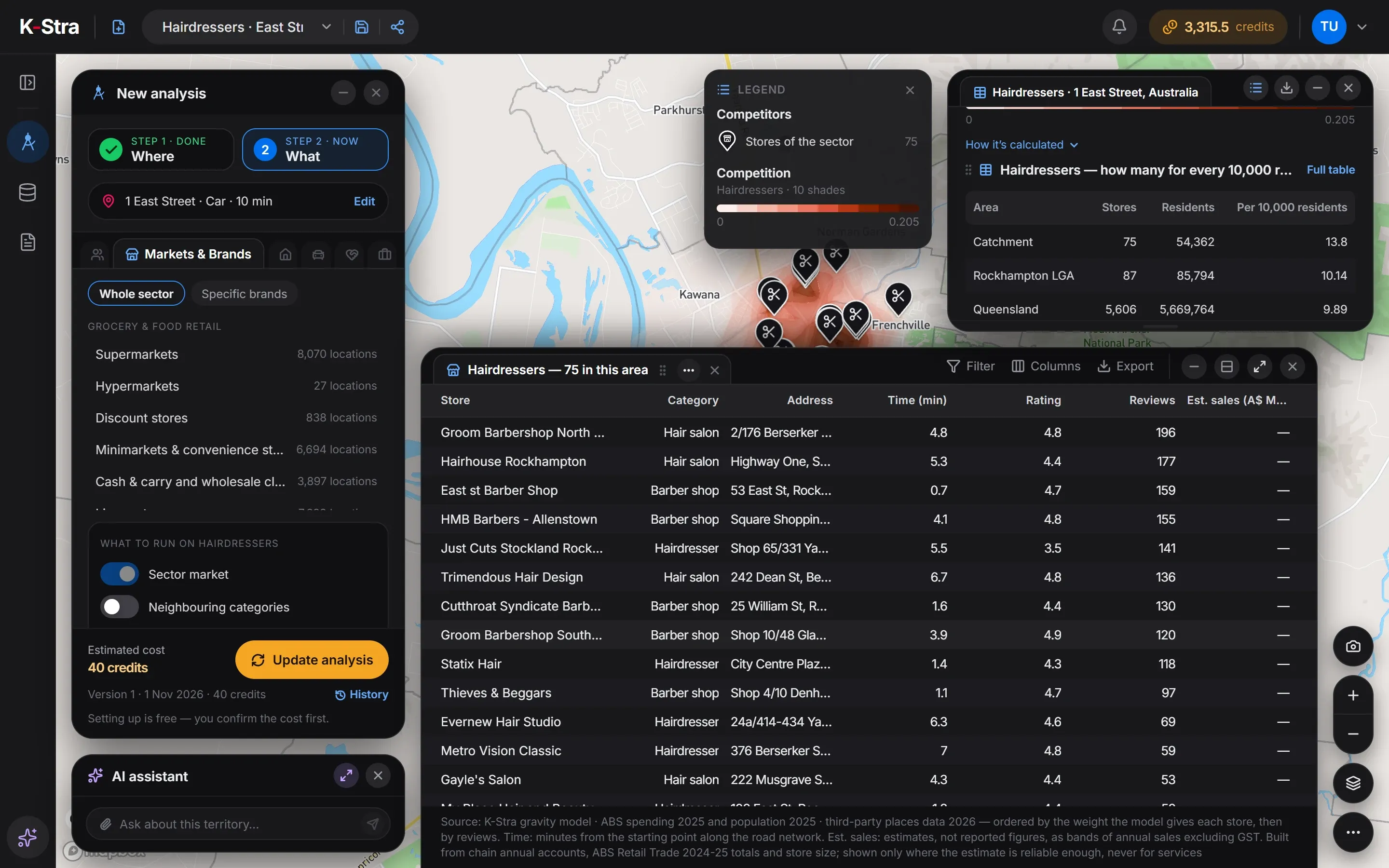 Salons · Rockhampton
How much does a salon analysis cost?
The Rockhampton example cost 40 credits. A whole city costs the same: you pay for the sector, not the size of the area.
- Markets & Brands, Hairdressersper sector, any area40 credits
- Maps, tables and exports of the resultsFree
- Total= 40 credits
- ≈ A$61 at the Single report pack rate of A$1.53 a credit; less with larger packs and monthly plans. A new free account’s 40 welcome credits cover it.
Optional, not in the total
- Neighbouring categoriesper set+ 2 credits
- People & Economy, Ageper topic+ 2 credits
- Compare candidate sitesper candidate site+ 20 credits
The estimate appears before the run starts, and a run that fails costs nothing.
What do people opening a salon ask next?
Where do my clients come from?
Put client counts by postcode on the map, without names, and find the areas that bring most of the business.
Customer mappingWhich of my candidate sites is stronger?
Run the same model on one to five addresses and compare the residents’ spending each could capture, and from which salons. It counts residents’ spending only, so use it to compare sites in the same sector and area: the absolute value is an order of magnitude, and workers, commuters, tourists and passing trade are not in it.
Retail site selectionHow do I split areas between franchisees?
Territories with a similar number of residents for each salon, within a reasonable drive.
Franchise territory planning
What else do people ask about salon locations?
How many residents does a hair salon need in Australia?
On average there is one hairdresser, salon or barber for every 1,074 Australians: 25,702 for 27,613,654 residents, or 9.31 per 10,000. A salon with several chairs needs more than that, a solo barber fewer.
Are barbers counted with hairdressers?
Yes. The Hairdressers sector holds hair salons, hairdressers and barber shops, and the table shows which is which: in the Rockhampton example 33 hair salons, 29 hairdressers, 13 barber shops.
Does K-Stra show the estimated annual sales of other salons?
No. Hairdressers, beauty centres and spas are services, and services never have an estimated annual sales band in K-Stra: the estimate is for existing retail stores only, always as a band with its confidence, and never as a figure. Ratings and the number of reviews in the table are the public sign of which salons are busy.
Can I see beauty clinics and day spas as well?
Yes, as two separate sectors: Beauty centers and Wellness & spa, each with its own demand and competition. A hair salon analysis can also add them as neighbouring categories, together with perfumeries, gyms, pharmacies, clothing and cafés, for 2 credits.
Does the age of residents matter for a salon?
It changes the offer more than the size of the market: barbers, colour, bridal and beauty treatments sell to different ages. The Age topic of People & Economy shows the age profile of a catchment for 2 credits.
Find the suburbs
short of salons.
Type an address, pick Hairdressers and read residents, competition and the gaps on one map.
Open the app — free to exploreExploring the map is free; you pay only for the analyses you run