How many people live in the Northern Territory, and where?
Few residents, vast distances and a young population that mostly rents: the Northern Territory is a set of separate markets, with Darwin as the only large one.
The Northern Territory had 264,556 residents at 30 June 2025 on a sixth of Australia’s land. 60.0% live in Greater Darwin. It has the youngest population in the country, with a median age of 33.9, and residents spend about A$55,549 each a year, above the national average, although incomes outside Darwin are far lower.
What are the key figures for the Northern Territory?
| Indicator | Northern Territory | Australia |
|---|---|---|
| Residents, 30 June 2025 | 264,556 | 27,613,654 |
| Average yearly change, 2019–2025 | 1.22% | 1.50% |
| Residents added since 2019 | 17,997 | 2,278,828 |
| Area | 1,348,135 km² | 7,688,095 km² |
| Residents per km² | 0.2 | 3.6 |
| Share in Greater Darwin | 60.0% | — |
| Median age | 33.9 | 38.5 |
| Aged under 15 | 20.2% | 17.4% |
| Aged 65 and over | 9.7% | 17.5% |
| Income index | 106.0 | 100.0 |
| Consumption index | 105.6 | 100.0 |
| Spending per resident, a year | A$55,549 | A$52,582 |
| Resident spending, a year | A$14.7 billion | A$1,452.0 billion |
| Families (Census 2021) | 54,497 | 6,730,182 |
| Homes rented (Census 2021) | 54.8% | 33.6% |
| Flats and apartments (Census 2021) | 24.4% | 19.6% |
- Residents: ABS Estimated Resident Population at 30 June 2025, by council (2025 boundaries). Change: ABS Estimated Resident Population by council, 2019 to 2025; average yearly change as in the K-Stra area dashboard.
- Age: ABS population by five-year age group at 30 June 2025; median age worked out from the age groups. Capital: Greater Capital City Statistical Areas (ABS ASGS Edition 3), residents counted by K-Stra on the address points inside them.
- Indices: Income index from ABS Personal Income 2022–23 (tax data), measured or estimated; consumption index derived from it; 100 = Australia. Spending: Spending per resident from the consumption index and ABS national accounts (5204.0) for 2024–25. Housing and families: ABS Census 2021 (families, rented homes, flats and apartments).
Where do people live in the Northern Territory?
Greater Darwin counts 158,821 residents, mostly in three councils: Darwin with 90,035, Palmerston with 43,193 and Litchfield with 24,849. The rest of the territory, 105,735 residents, is spread across Alice Springs, Katherine and hundreds of small communities.
The two halves earn very differently: Greater Darwin has an income index of 120.3, the outback region 86.7. In 2021, 54.8% of households rented their home, the only state or territory where renters were the majority.
| Area (capital city, then SA4 regions) | Residents 2025 | Share | Median age | Income index |
|---|---|---|---|---|
| Greater Darwin | 158,821 | 60.0% | 34.7 | 120.3 |
| Northern Territory – Outback | 105,735 | 40.0% | 32.6 | 86.7 |
Residents counted by K-Stra on the address points inside each area; median age from the five-year age groups, income index weighted by residents. The income index comes from ABS personal income tax data for 2022–23, measured for councils and SA2 areas and estimated elsewhere; 100 is the Australian average.
Which councils in the Northern Territory are growing?
Palmerston grew 13.1% from 2019 to 2025, on average 2.18% a year, and Alice Springs 1.98% a year, against 1.22% a year for the territory (7.3% in all). The City of Darwin grew 0.92% a year. In six years the territory added 17,997 residents, fewer than a single growth council in Melbourne or Sydney.
Palmerston is also the youngest council, with a median age of 32.3, and has the highest income index of the territory’s larger councils, 124.2.
| Council | Residents 2019 | Residents 2025 | Change a year | Rank |
|---|---|---|---|---|
| Palmerston | 38,200 | 43,193 | 2.18% | Fastest |
| Alice Springs | 27,600 | 30,875 | 1.98% | 2 of 4 |
| Litchfield | 23,331 | 24,849 | 1.08% | 3 of 4 |
| Darwin | 85,308 | 90,035 | 0.92% | Slowest |
Councils with more than 20,000 residents in 2025. Average yearly change = (residents 2025 ÷ residents 2019 − 1) ÷ 6, on 2025 council boundaries.
How much do residents of the Northern Territory spend, and on what?
The territory’s consumption index is 105.6: residents spend A$55,549 each a year, A$2,967 more than the average. In all they spend A$14.7 billion a year, 1.0% of the Australian total, most of it in Greater Darwin.
| Category | Per resident, NT | Per resident, Australia | Total, NT (A$ million) |
|---|---|---|---|
| Food and non-alcoholic beverages | A$5,145 | A$5,032 | 1,361 |
| Alcoholic beverages, tobacco and narcotics | A$1,556 | A$1,509 | 412 |
| Clothing and footwear | A$1,924 | A$1,869 | 509 |
| Housing, water, electricity, gas and other fuels | A$13,374 | A$12,788 | 3,538 |
| Furnishings, household equipment and routine household maintenance | A$2,432 | A$2,243 | 643 |
| Health | A$4,066 | A$3,823 | 1,076 |
| Transport | A$5,882 | A$5,558 | 1,556 |
| Information and communication | A$1,007 | A$956 | 266 |
| Recreation, sport and culture | A$5,791 | A$5,380 | 1,532 |
| Education services | A$2,045 | A$1,862 | 541 |
| Restaurants and accommodation services | A$4,820 | A$4,447 | 1,275 |
| Insurance and financial services | A$4,394 | A$4,146 | 1,162 |
| Personal care, social protection and miscellaneous goods and services | A$3,113 | A$2,969 | 824 |
| All categories | A$55,549 | A$52,582 | 14,696 |
Spending per resident from the consumption index and ABS national accounts (5204.0) for 2024–25. Spending of residents, wherever it happens; visitors are not included.
How many businesses of each kind does the Northern Territory have?
The Northern Territory has 11.87 fuel stations per 10,000 residents, three times the national 3.74, and 4.61 supermarkets against 2.92: distances need many small outlets. Hairdressers (6.12) and aged care sites (1.29) are the fewest per resident of any state or territory.
| Sector | Locations in NT | Per 10,000 residents | Australia |
|---|---|---|---|
| Supermarkets | 122 | 4.61 | 2.92 |
| Pharmacies | 56 | 2.12 | 2.63 |
| Gyms & fitness centers | 172 | 6.50 | 7.06 |
| Bars & cafés | 371 | 14.02 | 12.00 |
| Restaurants | 339 | 12.81 | 12.17 |
| Hairdressers | 162 | 6.12 | 9.31 |
| Childcare & early learning | 136 | 5.14 | 5.24 |
| Aged care & retirement living | 34 | 1.29 | 2.50 |
| Fuel stations | 314 | 11.87 | 3.74 |
| Real estate agencies | 94 | 3.55 | 5.34 |
| Hotels & accommodation | 663 | 25.06 | 15.11 |
K-Stra places catalogue, October 2026, as the app classifies each business; residents at 30 June 2025. A higher count per resident can mean smaller outlets, visitors or a crowded market: the catchment of each site tells which.
What can you see about the Northern Territory without an account?
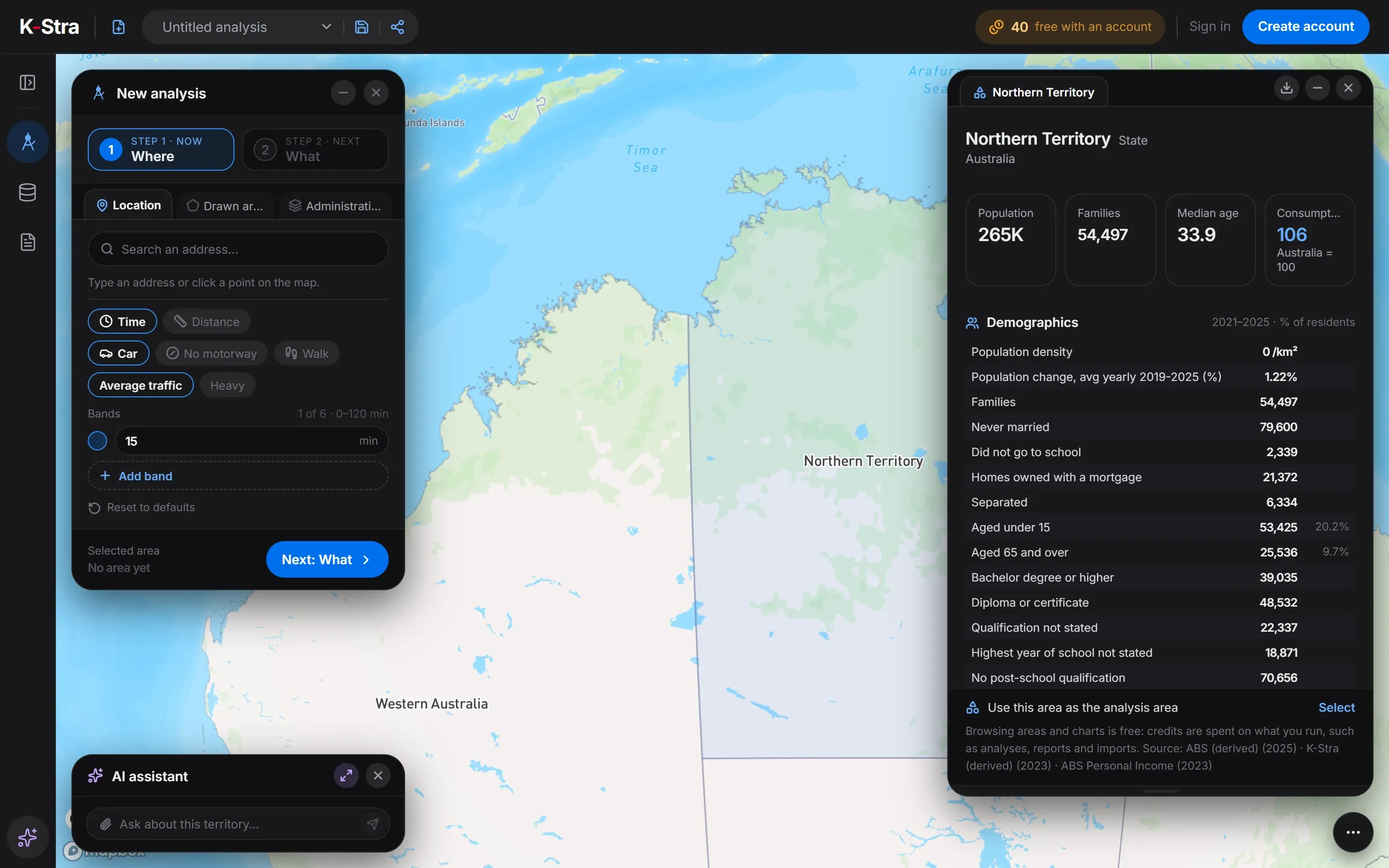 No account needed
On the map of Australia, a click on “Northern Territory” opens this dashboard; zooming in, the same click works on every council, postcode and suburb in the NT. Browsing them costs nothing.
Figures for the whole of the Northern Territory are a starting point: credits start when you measure the catchment of one of its addresses — the residents within a drive, their spending and the competitors already there.
What does this mean for choosing a location in the Northern Territory?
Outside Darwin, a catchment drawn by drive time is the only honest measure: a town of a few thousand people can be the only shop for hundreds of kilometres, and a radius of 10 kilometres says little about who comes.
In Darwin and Palmerston the market is young, renting and earning above average, with relatively few aged care sites and hairdressers per resident. It is also small: an opportunity for one site rarely supports a second nearby.
Defence and government postings bring many residents for a few years at a time, so the population changes faster than in the slower-moving states, and recent figures matter more.
What else do people ask about the Northern Territory?
What is the population of the Northern Territory?
264,556 at 30 June 2025 (ABS estimate), about 1.0% of all Australians. Greater Darwin accounts for 158,821.
Is the Northern Territory the youngest part of Australia?
Yes: its median age is 33.9 against 38.5 for Australia, 20.2% of residents are under 15 and only 9.7% are 65 or over.
Which is the largest town in the Northern Territory outside Darwin?
Alice Springs, with 30,875 residents in its council area, followed by Katherine with 11,282.
Open the Northern
Territory on the map.
The app opens on the territory: click a council for its free dashboard, or draw a drive time around a town.
Open the app — free to exploreBrowsing areas and dashboards is free